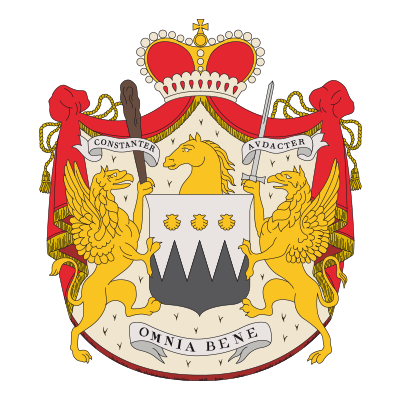
History

Very few families can claim and be proud of a thousand years of recorded history. The Ruffo di Calabria family has maintained feudal control and governed over the present-day regions of Calabria and Sicily for over 800 years uninterrupted. This has earned the family the prestige of being included among the oldest and most distinguished families of the Italian aristocracy.

The Origins

The Origins

The antiquity of the origins of the Magna Domus of the Ruffo di Calabria has long been the subject of discussion among hagiographers and genealogists. Simone da Lentini, bishop of Syracuse, wrote of it in the second half of the thirteenth century: “Rufa, nobilissima et vetustissima familia, tempore romanae reipublicae magnopere vixit et usque ad meum tempus potentissime vivit.”

Giovanni Fiore, writing in the seventeenth century, offered a more detailed account, noting: “Remote origins are attributed to the Ruffo di Calabria, as though their name derived from the Latin Rufus. Chroniclers recount that the Ruffo and the Giuliani were lords of vast territories, so that around the year 1000 ‘the emperor of Constantinople, having allied himself with them, recovered Apulia and Calabria.’ Others, however, consider them of Norman origin: Filippo and Errigo Ruffo, in the service of Guiscard, are said to have occupied Terra d’Otranto and Basilicata.”

Historical records

Historical records

The earliest Ruffo whose presence in Calabria is recorded is said to have been Giovanni Fulcone, who lived in the ninth century and is regarded as the father of Berenice, Empress of the East. Information concerning him is drawn from various ancient authors.

For verifiable historical evidence concerning the Ruffo di Calabria and for a documented and uninterrupted genealogical line extending to the present day, it is necessary to begin in 1235 with Pietro I Ruffo di Calabria, general of Emperor Frederick II.

His second son, Giordano, is still recognized as one of the earliest authors in the field of hippiatric medicine. He composed the treatise De medicina equorum, which, in addition to representing one of the oldest surviving examples of the Sicilian language, constitutes the earliest work of veterinary medicine to examine and describe in detail the techniques of horseshoeing.

Fulcone, grandson of Pietro I—also known as Folco—was knighted by Frederick II in 1247 and received the fiefs of Santa Cristina and Placanica. Besides distinguishing himself as a valiant soldier and as one of the poets associated with the literary school that flourished at the imperial court, Fulcone is regarded as the progenitor of all the Ruffo branches still extant today. He was present at the death of the Emperor and signed his testament as a witness.

Until 1400

Until 1400

The Ruffo di Calabria, divided into several branches, remained continuously present in Calabria for more than eight centuries, maintaining considerable feudal authority and holding important administrative, military, and courtly offices.

Among the most distinguished figures was Pietro II, grandson and namesake ancestor of Pietro I, who exercised considerable influence during the reigns of Charles I and Charles II of Anjou. He became the founder of the Catanzaro line, which became extinct at the end of the fifteenth century in the Centelles Ventimiglia family.

Guglielmo, head of the Aulic Council, became the first Count of Sinopoli in 1335. His son Carlo moved to Provence in 1347, thereby founding the line of the Ruffo, Counts of Bonneval and Marquises of La Fare.

Carlo, Count of Sinopoli, was a steadfast supporter of the Angevin dynasty and served as the principal military supporter of Queen Joanna II.

From 1500 onwards

From 1500 onwards

At the beginning of the sixteenth century the branch of the Ruffo, Dukes of Bagnara, emerged, from which four further lines developed: the Princes of Scaletta, the Princes of Castelcicala, the Dukes of Baranello, and the Princes of Floresta.

During the seventeenth century the presence of the Ruffo became more prominent within the chivalric and ecclesiastical orders. In earlier centuries the family had already produced numerous bishops, but only one cardinal: Pietro Ruffo, who was elevated to the cardinalate by Pope Gelasius II in 1118.

In the eighteenth century the Ruffo produced four cardinals and approximately fifty professed knights belonging to various chivalric orders, most notably the Order of Malta.

Particularly renowned was Fabrizio Ruffo, who at the head of the Sanfedist forces reconquered the Kingdom of Naples for the Bourbons. The figure of this prelate has been judged in sharply contrasting ways over the past two centuries; however, modern historiography has largely cleared him of the infamous accusation that he betrayed the terms of surrender that he himself, as victor, had granted to the Neapolitan patriots.

Among the most notable figures in more recent times is Fulco Ruffo di Calabria, a fighter ace of the First World War and later a senator of the Kingdom of Italy. Fulco has also been credited, together with Francesco Baracca, with playing a decisive role in the early development of the Italian Air Force.


INSIGHTS