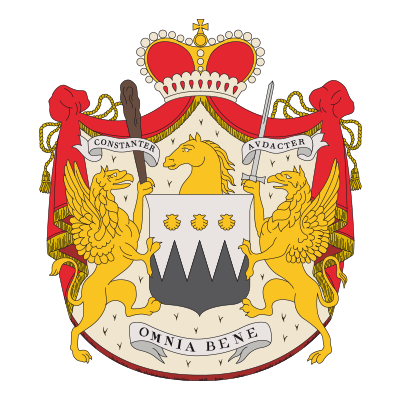

by Giovanni Ruffo
Ten years ago (1995) I wrote for the journal Calabria letteraria the article reproduced here, to which I have now added several updates in the light of newly acquired evidence.
In past years I had been encouraged by the late Director Frangella to revise and update the article, which had pleased him.
Director Frangella is no longer with us, and I believe I honor his memory by following the advice he gave me so many years ago.
I offer this updated article to the new Director, Franco Del Buono, together with my wishes for serene and fruitful work. He is certainly worthy of his distinguished predecessor.
In barely another lustrum it will be two hundred years since Fabrizio Ruffo of Bagnara, Cardinal of the Order of Deacons of the Holy Roman Church, has awaited from history an act of justice: that he be finally freed from the falsehoods and partisan fabrications—at every period suggested and nourished by the political climate of the moment or influenced by the milieu from which they arose—which turned him into the leader of brigand bands who, after obtaining the capitulation of Naples, drowned in blood the last gasp of liberty of the republican patriots.
Whether his cause was just or unjust, he has that right.
In truth, history rehabilitated him long ago. Yet there are still people in the world of culture who have never accepted that rehabilitation and who, in judging him, continue to rely almost as if they were Gospel on the writings of Cuoco, Botta, and Colletta. These authors, who even when writing history were unable to rise above the emotions derived from their position as contemporaries and participants belonging to the camp of the defeated, wrote the most infamous things about the Cardinal. Today, when archival consultation is possible even with limited effort, it is easy for anyone unwilling to accept the rehabilitation carried out by Italian and foreign historians to conduct specific research and reopen the case, should new and historically reliable documentary evidence emerge.
Vincenzo Cuoco, a scholar of literature, philosophy, and economics, was exiled from Naples for having adhered to the Republic. During the French domination he returned to Naples in 1806, where he held high offices, which he retained even after the return of the Bourbons. Among other works, he wrote in 1800 the Historical Essay on the Neapolitan Revolution of 1799. The falsehoods, insults, and atrocities he attributed to Fabrizio Ruffo may be partly explained, though not justified, by his inability to verify the information being reported to him. Moreover, communication was so difficult that news of the progress of the Sanfedist expedition reached Naples only when those troops had already arrived at Nola, in other words at the gates of the city. Cuoco himself wrote this on p. 263 of the second edition of his book (1806), in which, admitting that he had written only on the basis of his own memories, he could not avoid revising some of his earlier assertions, though only with regard to certain events.
Carlo Botta, a Piedmontese, was a military doctor attached to the French armies. He was a politician and the author of three historical works. In one of them, History of Italy from 1789 to 1814, he did no better than join the partisans in the chorus of slanderous lies to which those contemporaries of the Cardinal resorted when writing of his enterprise. In the opinion of historians, the work suffers from the lack of direct information and is devoid of critical judgment. In it, Botta reproduced almost word for word what Cuoco had written.
Pietro Colletta was a general of the Neapolitan army. In 1799 he adhered to the Republic, but when the monarchy was restored he returned to the service of the Bourbons. He later passed into the service of the French during the decade of their rule over the Kingdom of Naples. During that period he was, among other things, judge in famous political trials. In his History of the Kingdom of Naples—a work universally acknowledged to be not only partisan but also of limited scientific value—he confirms his animosity and prejudice by presenting Fabrizio Ruffo in terms that are openly defamatory, insulting, and false. He wrote of him in these words:
“Fabrizio Ruffo, born of noble but corrupt stock, cunning by nature, ignorant of science and letters, dissolute in youth, lascivious in old age, poor in household, a squanderer, took in his green years the rich and easy road of prelacies. He pleased Pope Pius VI, from whom he obtained the highest office in the Papal Camera; but, because of too many and too sudden gains, having lost office and favor, he returned wealthy to his homeland, leaving in Rome powerful friends, acquired, as in a corrupt city, through gifts and the blandishments of fortune.”
Of a different opinion from Colletta and from the two other authors mentioned above were other Neapolitans, scrupulous students of the history of that time, such as Benedetto Croce, Raffaele Palumbo, and Benedetto Maresca, who shed light upon and placed in proper perspective the events and the persons involved in the drama that bloodied Naples at the end of the eighteenth century.
But how did Fabrizio Cardinal Ruffo come into being, and who was he really?
He belonged to a branch of the most ancient House of the Ruffo di Calabria: the line of the Dukes of Baranello and Princes of Sant’Antimo, who in 1799 became Dukes of Bagnara, owing to the extinction of the principal branch.
Fabrizio Ruffo was born at San Lucido, a barony of his family, on 16 September 1744, to Duke Letterio Ruffo and Giustina Colonna, Princess of Spinoso, Marchioness of Guardia Perticara, and Lady of Accetturo and Gorgoglione.
Since I must say something about the education received by the child Fabrizio, I consider it useful to quote what Abbot Domenico Sacchinelli wrote, ten years after the Cardinal’s death, in Historical Memoirs on the Life of Cardinal Fabrizio Ruffo, because he records an episode that may help explain the interest later shown by Pope Pius VI toward Cardinal Fabrizio:
“He had not yet completed his fourth year when he was brought to Rome to be educated there under the protection of his uncle (in truth his great-uncle, being the brother of his grandfather Paolo), Cardinal Tommaso Ruffo, then Dean of the Sacred College. Present at that Cardinal’s court, in the capacity of auditor, was the Prelate Giovanni Angelo Braschi of Cesena, who, in order to caress little Fabrizio, took him onto his knees. Fabrizio wished to play with Braschi’s beautiful hair: he tried several times to unfasten the ringlets, but was always carefully prevented from doing so; at last, annoyed by that obstacle stronger than his own powers, he struck him on the cheek with his little childish hand—a slap of which there will be occasion to speak.
The loving care of Cardinal Tommaso for Fabrizio’s education and studies was not without great effect. He far surpassed the expectations held of his sublime talents; and while still young had already acquired a reputation for great learning in philosophy, and especially in the physical sciences and in political economy; and thus he left behind in the illustrious Collegio Clementino, in which he spent several years as a pupil, the same great renown as his uncle Cardinal Tommaso had left there, a man most worthy of the Papal Tiara, as Muratori calls him in his annals.
When Giovanni Angelo Braschi ascended to the Chair of Saint Peter under the name of Pius VI, he had not forgotten the slap he had received, and often, in a tone of benevolence, would mention it to Fabrizio. That sovereign benevolence did not remain inactive; for, both through Fabrizio’s personal merit and through gratitude to the memory of Cardinal Tommaso, the Holy Father did not delay in appointing him first Clerk of the Camera and then Treasurer General of Rome, which at that time—let this be said for those who may not know it—was the most conspicuous and important office in the Papal State; for in Rome the Treasurer possessed those same functions which in other kingdoms are divided among the ministers of finance, the interior, war, and the navy.”
Regarding this appointment as Treasurer, the Austrian Baron von Helfert, who studied with great meticulousness all that had been written on the revolution and counter-revolution of 1799, wrote in his book Fabrizio Ruffo…:
“In that office Ruffo not only carried out a number of measures useful to the general public, but also brought into order the entire system of papal finance.”
And further:
“No doubt the firmness with which he carried those measures into effect did not fail to bring him disfavor; a great part of the privileged classes was angry with him for having diminished ancient feudal rights; smugglers hated and cursed him because the new customs regulations ruined their trade […] Yet the breadth of his knowledge was admirable; writings of his survive on springs and waterworks, on the habits of different species of pigeons, on the movements of militias, on the equipment of cavalry. The Romans as a whole had more reason to be grateful to him than to mock him; his name is linked to institutions whose beneficial effectiveness still endures to this day. No one could attack him in the integrity of his public character. Even his adversaries were compelled to do him justice, and to confess that whatever he undertook he knew how to bring to completion with rare energy and unquestioned ability.”
The prudence and capacity of Treasurer Ruffo were such that Pope Pius VI proposed to him that he find a way to strengthen and render economically productive agriculture in the State of Castro and the Duchy of Ronciglione. The agrarian reform carried out by Ruffo raised the income from those lands from 50,200 scudi to 67,200. But the chief beneficiaries were the peasants, to whom the lands were granted in perpetual emphyteusis in the male line, continuing through the males of the last female of each emphyteuta. The Pope was so pleased that he wished to extend this reform to the whole Papal State. These reforms, which in practice abolished feudal abuses, were appreciated all the more because they had been conceived and put into practice by a Cardinal belonging to one of the most illustrious families of the Neapolitan nobility, itself rich in fiefs. The agrarian reform and the opportunities for well-being it granted the peasants, however, won him the hostility of the feudal nobility and the great landowners. Yet in every circumstance his sense of the State and his awareness that a minister must always act in order to safeguard the higher interest of the Nation gave him the strength to rise above opportunistic considerations and the courage to oppose whatever he believed unjust and harmful to the common good. In this regard, the anonymous author of the History of the House of Ruffo wrote in 1873:
“…his fame was so popular that he is still celebrated as a model treasurer, a great economist, a man of magnanimous plans and of grand and beneficial works.”
As a man, his nature was humane and generous. Sacchinelli and von Helfert recount an episode confirming the sensitivity of his soul. One day, while visiting the hydraulic works for draining the Pontine Marshes, and wandering alone into the forest in pursuit of game, the Cardinal saw a laborer struck down by malaria. He loaded the man onto his own shoulders and carried him a long way along the path to his carriage. He took him to Rome, to the Hospital of Santo Spirito, where he had him treated at his own expense.
Colletta wrote that the Cardinal left the office of Treasurer a rich man. Sacchinelli did not share that view, for he wrote in turn:
“Ruffo’s disinterestedness and spotless conduct in the exercise of the rich office of Treasurer recalled to Rome the ancient heroes of history. In that very office in which others, from poor men, became rich in a short time, he, after many years in its exercise, had not formed for himself a fund sufficient to cover the indispensable expenses of the cardinalitial attire. He was therefore forced to borrow money at interest, pledging, with prior pontifical brief, the properties of the Ruffo prebend.”
Nor did von Helfert say anything different on this point:
“Raised to the cardinalate in the Consistory of 29 September 1791, Ruffo left his post as Treasurer, which had enabled his predecessors to amass great wealth, and left it empty-handed, so much so that he had to contract a loan in order to cover the first expenses of his new dignity.”
I must, however, point out an error in this assertion by von Helfert. It is true that Ruffo’s nomination to the cardinalate dates from 29 September 1791—one of those nominations then called in pectore—but it is equally true that it was made public only on 21 February 1794, and that Ruffo continued to exercise the office of Treasurer General and the other functions entrusted to him throughout 1792 and 1793, and for part of 1794. This serves as clear proof that the Pope did not make him a Cardinal, as Colletta claimed, in order to remove him from Rome and from the office of Treasurer: when Fabrizio Ruffo left the offices of government and Rome, he had already been a Cardinal for three years.
It remains to clarify the origin of Fabrizio Ruffo from “noble but corrupt stock” and the claim that he was “ignorant of science and letters,” as Pietro Colletta wrote.
To the first assertion of Colletta, Alexandre Dumas replied:
“His birth, therefore, as may be seen, was not only noble but illustrious. Indeed there is an Italian proverb which, in indicating the foremost principles of nobility in the various lands, says: The Apostles in Venice, the Bourbons in France, the Colonnas in Rome, the Sanseverinos in Naples, and the Ruffos in Calabria. Now it has been seen that the Cardinal was Ruffo by his father and Colonna by his mother.”
Corrupt stock! This now brings to my mind what historians wrote of Fulcone Ruffo di Calabria, poet and glorious soldier, beloved of that great Emperor Frederick II; or of Fabrizio Ruffo, Prior of Bagnara and Grand Prior of Capua, Captain General of the Hospitaller fleet, victor together with Morosini at the battle of Candia, who with skill and great valor saved at Zoclaria, near Canea, the bulk of the Venetian and French naval forces already overwhelmed by the Turks; or of Gaetano Ruffo, himself a poet and a shining figure of patriotism, who, yearning for the unity of Italy, watered the soil of Calabria with his young blood; or, to come to our own times, what was written about Fulco Ruffo di Calabria, the “Knight of the Sky,” hero and gold medal recipient of the War of 1915–1918. But General Pietro Colletta evidently did not know history, nor did he live long enough to know the martyrdom of Gaetano and the heroism of the last Fulco.
To the third assertion—“ignorant of science and letters”—our own age is answered by Mario Casaburi in his biographical work Cardinal Fabrizio Ruffo (Rubbettino Editore).
Writing of the studies of the young Fabrizio at the exclusive Collegio Clementino, Casaburi gives the following information:
“[…] The fathers also encouraged among the pupils a healthy spirit of emulation. It was considered very useful in the various classes to have each month ‘some private or public scholastic exercise so that all may be practiced in recitation and each school may have its own honor through the progress of the students.’ The language of use for pupils and masters could only be Latin.
Without doubt, that of the Clementino was an environment congenial to Fabrizio’s character, and for fully twelve years he absorbed with extraordinary effectiveness all that was taught to him.
The young man soon overcame the understandable initial trauma; he was already accustomed to being away from home, far from parents, brothers, and sisters, and in a short time he became an outstanding element, a leader, of the Clementino, capable of imposing himself upon all and of distinguishing himself among his companions through intelligence, practical decisiveness, and above all through the great love he nurtured for the Latin and Greek classics […]”
When King Ferdinand IV learned that Ruffo was free of office at the Papal Court, he invited him to transfer to Naples, offering him the Intendancy of Caserta and the rich abbey of Santa Sofia of Benevento, declared to be under royal patronage and, for that very reason, contested by the papal government. Having obtained authorization from the Pope, the Cardinal moved to Caserta and devoted himself to the silk factories and manufactures of the colony of San Leucio, bringing them in a few years to a level of production never previously attained. Immersed in his studies, he lived at Caserta until 1799, dreaming—or perhaps even foreseeing—future “times and occasions for action.”
The last decade of the eighteenth century found the Kingdom of Naples in disastrous economic condition. Trade was stagnant, industry nearly paralyzed, and agriculture oppressed by absurd and complicated laws. The poorest classes were overtaxed, while the wealthier classes enjoyed fiscal privilege.
From the moment the Queen, the Austrian Maria Carolina, by virtue of the birth of the heir apparent, entered into the government—as provided for in the marriage contract—power had passed into her hands and into those of General Acton, whom the Queen had summoned to Naples in 1778. The King, more inclined to pleasures than to the cares of the Kingdom, which he detested, intervened in affairs of state only in order to endorse a reckless foreign policy, which led the country first to free itself from Spanish tutelage only to fall under Austrian and then English influence, the latter driving it into conflict with France.
By then the Kingdom was entirely in the hands of the so-called “English party,” with Acton as Prime Minister, Lord Hamilton as English ambassador—whose wife enjoyed the favors of the Queen (and of Nelson)—and with that Admiral, together with his fleet, in the harbor of Naples.
In 1793 the Neapolitan army numbered 36,000 men—in truth half of them poorly disciplined and ill-trained foreigners—and the navy 102 warships of various classes, armed with 618 cannon and manned by 8,600 sailors. On 12 July of that year, Prime Minister Acton and Lord Hamilton had the King sign an alliance treaty with England. This treaty placed the Neapolitan nation among those powers that held command of the Mediterranean. In spite of that armament—whose cost contributed not a little to the grave impoverishment of the Nation—and that treaty with the English, the Neapolitan government did not dare react and accepted French demands when Admiral La Touche appeared in the harbor of Naples with a squadron of 14 French warships to impose, under threat of cannon, recognition of the republican government of France, which the King had earlier refused to recognize.
The years that followed were unhappy for the Neapolitans. The police, in attempting to restrain and control the discontent more or less openly displayed by certain social strata, sowed terror through indiscriminate arrests, which the tribunals turned into severe sentences, and capital punishments were numerous. There had been the ill-fated war with France and the armistice of May 1796, imposed by Napoleon, victorious on Italian soil. But peace lasted little, and another disastrous war against France ended in a peace bought at a dear price and obtained on humiliating terms.
The year 1798 saw the troops of Napoleon in Rome, the proclamation of the Roman Republic, and the eighty-year-old Pope Pius VI driven into exile. He, a prisoner at Valence, died on 29 August 1799.
In the first six months of 1798, the Sicilian coasts suffered raids by the French fleet; but after the resounding naval victory won by Admiral Nelson in August of that same year at Aboukir, a new wind of courage arrived at the Court of Naples. But by then the fate of the Kingdom of Naples was already sealed. With the French army at its gates and the English within its walls, its independence was only apparent, and there was even the concrete danger that the oldest kingdom of the peninsula might disappear forever. Opposing French and English interests, in the absence of a wise foreign policy—one that might perhaps have had a happy outcome in earlier years—aimed at keeping the Nation neutral in a war in which it occupied an important strategic position, had transformed the Kingdom into a land to be conquered.
Domestic policy had been no wiser. The finances of the State, as has been said, were gravely weakened. The people were weary, and the higher social classes bewildered and divided. Intellectuals and the lazzari—the name which the Spaniards, during their rule, had given to the poorest and most destitute— the former decimated, the latter inflamed by the regime of persecution of the preceding years, now seemed ready to confront one another. Aristocrats and bourgeois were uncertain whom to support in order to defend their property. English interests and intrigues, so authoritatively represented within the government, had brought the country to the threshold of civil war, when the victorious French troops persuaded the Court to abandon Naples for Palermo.
The transfer took place aboard the English ship Vanguard, while Nelson sank the Neapolitan ships in the harbor; it was said, so that they should not fall into enemy hands. The departure of the royals took place at 8:30 p.m. on 21 December 1798, and had all the character of a true flight.
A month later, on 23 January 1799, General Championnet entered Naples, and the Neapolitan Republic was officially proclaimed. Strange destiny, that of this newborn Republic, which in those days inflamed the noblest and most distinguished Neapolitan minds, yet was destined, as it certainly was, sooner or later to yield to the prodigious ambition of power of the new French Caesar, to Spanish claims, or to English interests.
The English and the Spaniards, from time immemorial, did not love republics; and Napoleon, while creating them, was already showing signs of preferring monarchies himself. He demonstrated this in fact barely ten months later, when on 18 November 1799 he became First Consul, upon the ashes of the Directory and the Council of Five Hundred. From that moment not only did he create no more republics, but within a few years he would crown himself Emperor and transform into monarchies those few republics he had created, choosing kings from within his own family.
Benedetto Croce, in the preface to his The Neapolitan Revolution of 1799, wrote:
“[…] if the Neapolitan republicans had possessed full awareness of the situation, and had followed the instinct of their own preservation, only one line of conduct presented itself, simple and direct: to do to the French what, shortly afterwards, the French, when their own interest required it, felt no scruple in doing to them: abandon them and come to terms with their own Sovereigns.
Fortunately, the patriots of Naples were great idealists and poor politicians. No one thought of betraying the French and reaching an understanding with the Sovereigns; very many, selfless lovers of the Republic, were ready to defend it to the utmost, whatever might happen. Thus they kept their tottering Republic standing, even after the departure of the French army, amid boundless illusions and meager results, bold intentions and inadequate means: a life oscillating between comedy and tragedy, until at last the latter prevailed. The Republic fell. But if the patriots of Naples, through their idealism, their obstinacy, and their lack of political sense, went to certain ruin, it was these same facts and circumstances that saved the fruit of their work. In history, immense is what might be called the efficacy of the unsuccessful experiment, especially when there is added to it the consecration of a heroic fall.”
On 14 January 1799, Cardinal Fabrizio Ruffo arrived in Palermo. The reasons that detained him in Naples for a full three weeks are not known. The oral tradition of the House of Bagnara maintained that Fabrizio—who had strongly advised the King against transferring the court to Palermo (and documentary evidence of this in fact exists), a transfer that he considered an unnecessary, shameful, and in any case premature flight—remained in Naples in order to evaluate the possibility of reorganizing at least part of the army, now left without command, and of opposing the weak French invasion forces. His brother Francesco reached Palermo even later, together with General Pignatelli, who by royal mandate should have defended Naples. Both were arrested at the moment of landing, but released the following day after Pignatelli presented justifications that the King deemed valid.
Oral tradition cannot be granted the force of historical document; I have reported it here only because the same thesis was maintained by other authors.
The Cardinal found the Court at Palermo immersed in an atmosphere of discouragement and fear. The King seemed to flee from the tragic reality, resigned and absent. The Queen, whose only hope of salvation rested in Admiral Nelson, wrote in those days to her confidante Lady Hamilton: “here we are all more dead than alive.”
Piero Bargellini, in his novel Fra Diavolo, thus described the court environment in those first weeks of exile:
“Only one figure, whom we have never yet named, moved about the court with a face in which there was neither cowardice nor indolence. He was fifty-five years old: his long hair, prematurely whitened, curled over his ears almost by nature. In his pale face were set two blazing Calabrian eyes. A long nose and a sealed mouth. His clothing was all black and tightly buttoned, with a cross upon his breast and, on his left shoulder, a red mantle: a prince of the Church. […] He was Cardinal Fabrizio Ruffo, born in Calabria, educated in Rome by the canon of Cesena who, under the name of Pius VI, would die a prisoner at Valence. Far from being ignorant, as has unjustly been written of him, he had devoted himself to the science of the age—political economy—maintaining even in his writings a sense of realism and balance that the ‘abstract speculators,’ as he himself calls the unhappy enlighteners, did not possess.
Having displeased the feudal lords through the emphyteutic reform—which would later be attributed solely to Leopold of Tuscany—having displeased speculators through freedom of trade—which would later be attributed solely to the revolutionaries—having damaged smugglers and their protectors through customs reforms, he was dismissed from Rome […]. Ill-regarded by Minister Acton, despised by Admiral Nelson, mocked by the King, who, as we have seen, had little sympathy for clerical dress, ignored by the Queen, who dreamed either of philosophers ruling states or generals conducting wars, Fabrizio Ruffo was scarcely tolerated in the palace at Naples. But in Palermo, in misfortune, that serene face and those eyes in the depths of which the fire of hope never seemed to go out began to acquire a new fascination. And that fascination increased when, not even twenty days after the Kingdom had been lost, it was learned that he was already thinking of reconquest.”
Armed with a royal diploma naming him Vicar General of the Kingdom, Fabrizio Ruffo moved to Messina, and from there embarked and landed in Calabria on the morning of Friday, 8 February 1799.
Regarding the beginning of the Cardinal’s enterprise, I quote what the late Prof. Gaetano Cingari, professor of modern history at the University of Messina, wrote in his book Jacobins and Sanfedists in Calabria:
“[…] In truth, Ruffo found very few means: the very first letters of his interesting correspondence from those months bring to light all the difficulties of that audacious expedition. In Messina, indeed, there were already clear signs of an impending Jacobin rising, which, had it managed to link Messina and Reggio together, would have shattered all his designs.
Nevertheless, the Cardinal did not allow himself to be halted by administrative obstacles or by the atmosphere of suspicion and fear that surrounded him on the day after his arrival in Messina. In fact, he was a man of great ability and, although he had no remarkable military experience, he possessed the distinctive qualities of an excellent leader: he was resolute and prudent and above all endowed with an innate sense of limit and opportunity. Moreover, born in Calabria, he knew the customs and perhaps to some extent the problems of the Calabrians; finally, as a man of the Church, he could count on the support of the prelates and, even more, of the lower clergy, whose vanity he knew how to flatter and whose too long trampled rights he knew how to recognize. […] Thus, although there were broad promises for the formation of a first strong nucleus of royalists, Ruffo found himself at Pezzo almost alone.”
At the landing at Capo Pezzo in Calabria, the Cardinal was accompanied by Marquis Malaspina, Abbot Lorenzo Sparziani, his valet Carlo Cuccaro, three servants, Annibale Caporossi, and Domenico Petromasi.
Once the first difficulties had been overcome, the march to reconquer the Kingdom began. Cingari writes:
“And one must not forget that Ruffo’s arrival in Calabria had awakened broad hopes among the Calabrians, especially among the lower people; it was hoped that the victory of the Sanfedist forces would bring tangible relief to economic and social life, by removing the most direct causes of the administrative disorder and recurring injustices of which the defenseless popular classes were the victims.”
From the same Cingari we learn—and the news, amply documented, stands in clear contrast to what had hitherto been written—that:
“Small indeed, contrary to every expectation, was the contribution from the towns situated in the Ruffo family’s fiefs, and almost negligible the participation of the inhabitants of Scilla and Bagnara.”
From the very beginning of his enterprise, the Cardinal demonstrated in deeds that he had at heart the good success of his expedition, but not at the expense of the higher future interest of the Kingdom. He had immediately realized—or perhaps this formed part of a project long meditated by him in previous years—the futility of radical economic measures which, though advantageous in the moment, would later prove dangerous to the economic and administrative structure of the State once peace had been restored. Cingari writes again:
“He resolved to eliminate the most burdensome imposts and, first of all—this must be noted—those which, because they enriched the galantuomini, more frequently provoked bitter popular reactions.”
Despite the grave worries and exhausting obligations that weighed upon him in those days, already from Monteleone (today Vibo Valentia) the Cardinal began to adopt measures aimed at alleviating the severe crisis in the silk trade, which had inevitably brought about a sharp contraction in the production of that commodity, long the best resource of the whole region. He removed not only the obtuse regulations of the General Administration, which in previous years had paralyzed that trade, but also modified the customs system in order to favor all commercial activity. Cingari writes:
“Unlike what the republicans had neither known nor been able to do, Ruffo tried to lighten the fiscal burden, eliminating, if not the heaviest taxes, certainly the most unpopular ones: the abolition of the annotatori and their substitutes and of the soprabilancieri, figures most hated in Calabrian life, more than any other measure served increasingly to draw the popular classes closer to Ruffo and to nourish the support of the royalists for the Christian Army. Which, also as a result of the edict of pardon granted to all those who, though compromised in the republican movement, returned to obedience, was preparing to march toward towns that were spontaneously ‘realizing’ themselves.”
The Cardinal left Monteleone with about 4,000 men, making for Catanzaro by way of several stages.
That city caused the Porporato no little concern, since the republican party was more deeply rooted there than elsewhere.
Until that moment the Cardinal’s men had found no opponents, the towns they encountered having “realized” themselves spontaneously.
But Catanzaro also “realized” itself spontaneously, while the Cardinal was still with his troops at Borgia, where a delegation from Catanzaro reached him to negotiate surrender. From that delegation the Cardinal also learned that in Catanzaro there reigned an atmosphere of terror and great anarchy, permitting atrocious private vengeance and savage crimes. He then wrote to Don Francesco Giglio, commander of the masses who were to enter Catanzaro, saying:
“[…] that war was to be waged only against obstinate Jacobins who stood with arms in hand, not against those who, though they had previously adhered to the rebels, had afterwards repented and submitted themselves to the clemency of the King, and still less against the property of peaceful citizens. He therefore ordered him, under his own responsibility, to see that the anarchy, plunder, private vengeance, and every other outrage committed by force should cease immediately.”
On the “realization” of Catanzaro, Cingari writes:
“Ruffo—as has been said—did not go to Catanzaro, but preferred to halt at the marina before resuming his march of reconquest. This, however, does not mean that he took no special care over the problems arising from the ‘realization’ of the capital of Calabria Ultra. On the contrary, he devoted the few days of his halt to seeking useful solutions to the internal problems of the city, reordering its administration and even entertaining the idea of separating Reggio from Catanzaro, not only in order to streamline administrative and judicial activity, but also better to control the political activity of the two cities, both deeply ‘corrupted’ and sources of dangerous upheavals. Moreover, he defined still more clearly his attitude towards popular demands, with measures aimed at moderating the rights of the barons without destroying them, moderating taxes and burdens for the benefit of the poor, and facilitating trade as much as possible without running the risk of internal scarcity.”
Once Catanzaro had been “realized,” the Sanfedist bands moved to conquer Cotrone, where they arrived in the night between 17 and 18 March.
Colletta wrote that Cotrone, after its first resistance, “asked terms of surrender, which the Cardinal refused, for having no money to satisfy the greedy hordes, nor the little gains made along the way sufficing, he had promised them the sack of that city. […] Cotrone was taken with slaughter of armed and unarmed citizens, and amid plunder, lust, and blind cruelties, without number.”
Professor Cingari, in his already cited Jacobins and Sanfedists in Calabria, writes that the details of the conquest of Cotrone, which took place during the night between 18 and 19 March, are known, when the republicans of that city attempted a sortie. That sortie enabled the men of Panzanera to prevent the gate from being closed, through which the bulk of the Sanfedist force was able to pass. From that moment began the fierce plundering of the goods of the noble and civil families:
“nothing was spared, although the lower people knew how to impose respect for women.”
The castle, still in the hands of the Jacobins, surrendered on 21 March, Holy Thursday. Cingari writes further:
“At that point Perez and Rajmondi sent the capomassa Don Giovanbattista Griffo to bring Ruffo the important news and—curious detail—their envoy was stopped and robbed by four brigands. Ruffo reached Cotrone on 25 March […]. Without doubt, the conquest of Cotrone, a well-fortified stronghold, which had worried him not a little during his expedition, gave him lively satisfaction. Yet he could not enjoy the deserved repose, since the sanfedists, having completed the sack, returned in great numbers to their home villages; and he therefore had to begin all over again to form the Christian Army.”
In that period the Cardinal wrote to General Acton that the Calabrians were slow to follow him, preferring to remain armed in defense of their own property and families, threatened by the many rebels who had fled.
When the Cardinal had departed from Monteleone for Catanzaro, a band of sanfedists had broken away from the main army and headed toward Paola under the command of Giuseppe Mazza, of a patrician family of Taverna.
Sacchinelli wrote:
“Here it must be observed that all those bloody battles given by the Cardinal’s army, recounted by the writers Coco, Botta, and Colletta, with burnings and sackings of the cities of Cosenza, Rossano, Paola, etc., were all dreams invented by those writers. In certain places various disorders did indeed occur at the moment of the counter-revolution, committed by the citizens themselves for private vengeance and out of lust for blood and plunder, evils inevitable in civil wars; but Cardinal Ruffo, with his army, never passed through those places and carried out his march along the Ionian route, as will be said later.”
Regarding Paola, however, Abbot Sacchinelli does not appear well informed. Paola was in fact sacked—and there were also four deaths—by sanfedist troops (the detachment commanded by Mazza) to whom “many people from San Lucido, mostly unarmed,” had joined themselves. Citizens of Paola even took part in the sack. This certainty is provided by a document published by Professor Cingari in the appendix to his already cited book. It is, however, entirely true that the Cardinal, at the head of the main body of troops, followed the Ionian route and therefore did not pass through Paola.
Still at Cotrone, where he was engaged in rebuilding his army, the Cardinal could write to Acton:
“The Calabrias are now entirely reduced to obedience to the King our Lord.”
With the spontaneous submission of the last Calabrian cities, the whole region had indeed been pacified, even though disorder and anarchy were still present in several towns.
Sacchinelli reports that, once the column under the command of Giuseppe Mazza had returned, having left Calabrian territory, the Cardinal wished to halt for a few days in the area of Sibari to review the troops at his disposal.
According to Sacchinelli, the army was composed as follows:
Regular infantry: ten battalions of 500 men each, all soldiers of the former disbanded army.
The cavalry numbered 1,200 horses, but the light horsemen bore the most varied weapons and dressed in what he calls “fantastical” fashion. Alongside this cavalry was a corps of baronial horse, well dressed and well armed, though its precise strength is not known: the Cardinal used it to prevent or at least limit desertion, plunder, and crimes in general.
The artillery consisted of eleven cannon of various calibers and two howitzers, with several ammunition chests. There were many gunners from the old army, but no officers.
The irregular troops were composed of one hundred companies, each of 100 Calabrian men, every company under the command of three chiefs. These irregulars would not increase in number as the march advanced, since the Cardinal’s future effort was directed only toward enlarging the number of the regular troops. They were armed “according to the custom of the Calabrians with muskets, pistols, bayonets, and knives.” Poorly clothed, they nevertheless overflowed with courage and enthusiasm.
At the moment of leaving Calabria, wishing to rid himself—and rid Calabria—of the convicts perfidiously sent to him by the English, the Cardinal formed them into a body of 1,000 men, placed them under the command of the bandit chief Panedigrano, and sent them to Commodore Trowbridge, “informing him that the corps of one thousand men, commanded by Panedigrano, had been formed from those convicts whom the English had landed on the Calabrian coast […].”
The march through Basilicata encountered no particular resistance. Just as had happened in much of Calabria, the populations of that region also returned spontaneously to accept royal authority. Only Altamura showed willingness to shut itself up in defense.
In Apulia the attitude of the population was no different from that in Basilicata. In that region, however, an event occurred that must have caused the Cardinal great displeasure, and one that served to make even clearer to him the hostile attitude toward him of the English party, which, as has been said, imposed its own policy at Court.
From a Russian frigate there disembarked on Apulian territory Chevalier Antonio Micheroux, minister plenipotentiary of the King of Naples to the Russian army, who circulated a royal letter dated Palermo, 31 March 1799, inviting the population to return under the authority of the Crown. Micheroux did not limit himself to this, but went on to dismiss the authorities recently appointed by the Cardinal, replacing them with men of his own choosing. At first glance, the intention of the minister might have seemed to be to cast doubt upon the authority of the Cardinal as Vicar General of the King and upon the legitimacy of the expedition; but on closer examination it much more likely constituted a first “test of the Cardinal’s ability and will to react”—if indeed, which would be even more serious, it was not an attempt to liquidate him by depriving him of authority in the eyes of his unruly and composite army. His reaction was immediate, firm, and so resolute that it persuaded the minister to re-embark in all haste. Restoring his own appointees to their offices, Fabrizio Ruffo ordered them to prosecute as enemies of the King anyone who opposed or altered his commands. At the same time he wrote to Micheroux, warning him against interfering in future in matters belonging to the competence of the Vicar General. It became entirely clear to the Cardinal that his design—namely, not to rage against the insurgents of whatever rank and responsibility, in order to make possible, after the reconquest of the kingdom, pacification and the recovery of national unity—was already producing concrete effects in opposition to other designs.
Perhaps this bitter realization helped ensure that he would not be unprepared when the Palermitan Court attempted to delay his victorious entry into Naples, in order to allow Nelson’s fleet time to anchor in its harbor.
Such miserable attempts, which incredibly bore the signature of the Sovereign, could hardly have encouraged the Cardinal, who was preparing to confront the rebellion of Altamura, a well-fortified city and one capable of offering real resistance.
Already from Policoro, Ruffo had expressed to President Acton some of his doubts about the orientation of the Court, which recommended rigorous measures against the Neapolitan Jacobins. And since it was therefore clear to him that the successes in Calabria of his expedition were already arousing the envy of his adversaries and concern among the government and the sovereigns, he wrote another letter openly inviting the King to join him, adducing reasons that ought to have led the sovereign to serious reflection.
These were the two letters sent by the Cardinal:
Policoro, 30 April 1799
“I have learned from a private letter that among the other things sent toward Procida there had been sent a criminal investigating judge, and it was also known that this was his office. I believe such a step impolitic and, the circumstances permitting, I take the liberty to lay before Your Excellency, unasked, my sentiments, which you may afterward value as shall seem most fitting. The difficulty of converting Naples, the greatest I see in the fear of deserved punishment, in the despair of never again being able to have offices, posts, or consideration, in the certainty of being forever, in the midst of the restored monarchical government, objects of suspicion and of bad treatment on every occasion. […] Now if we show a will to prosecute and punish, if we do not make them believe that we are fully persuaded that necessity, error, and the force of enemies, not wickedness, were the cause of rebellion, we shall aid the designs of the enemy; and we shall bar to ourselves the roads to reconciliation. It would seem even that, having in one’s hands any guilty man, even a great one, even distinguished in rebellion, one ought to pardon him. Such an example will make reconciliation appear possible to others and will divide them. Let one read the history of France and the many capitulations made with rebels, and one will see party leaders often pardoned, even though they had borne arms against kings […] And why ought there not to be employed the utmost clemency and with very few exceptions? Is clemency perhaps a defect? No, it will be said, but it is dangerous. I do not believe it, and, with some precautions, I believe it preferable to punishment, which cannot be carried out with justice. […] Of what use is punishment, indeed how is it possible to punish so many persons without leaving behind an indelible trace of cruelty? But I say more: this plan of punishment is impracticable and in itself destroys the possibility of success.
[…] I have always left flight open, because those who absolutely distrust us may depart without desperation and with the hope of returning one day to support the party again and recover their goods. I have been ready to receive rebels and even employ them, making them believe that their crimes were either unknown or that they had perhaps even done well, or at least innocently, in entering into rebellion; from all this it has come about that both the good and the bad have acted for me. The fear of being betrayed by such men might perhaps exclude this plan as dangerous, but I cannot see danger in it except when there is some foreign and imposing force giving tone to clubs of four bankrupts. […] Less rigor, I repeat, and let vengeance be renounced—or at least restricted and above all much delayed.”
Policoro, 30 April 1799
“I, Sir, have fired my small amount of powder; let His Majesty come and he will see how much still remains to be fired. Another consideration too ought to induce His Majesty. If these Russians and Turks come, it will be very difficult for me to govern them, to keep them in check, and they will destroy half the world; but under His authority they will do only what must be done. I still hope for this happy day.”
On the morning of 9 May, Altamura was surrounded by the Sanfedist troops. Two days earlier soldiers from that city had captured two Sanfedist engineers who had approached to study the fortifications. That same day the Cardinal had sent into the city a negotiator, Don Raffaele Vecchioni (though he seems in fact to have been called Giobatta), furnished with credentials authorizing him to negotiate surrender and the release of the two engineers. He was admitted into the city but never returned.
On the same day, 9 May, the Cardinal reached Altamura and personally wished to inspect the enemy fortifications.
The walls were strong and from the bastions came a heavy fire of muskets and culverins. The Cardinal noticed that on the northern side of the walls there was a gate known as Porta Napoli. With the intention of leaving the defenders the possibility of escape, he ordered that side of the walls to be left uninvested. He had already noticed that morning that a multitude of armed men from Altamura, who at the arrival of the Sanfedist troops were outside the walls, had not re-entered the city but had withdrawn northward. This made the Cardinal hope that, taking advantage of the night, the defenders still inside the city might also choose flight. And indeed this happened during the night. On 10 May, after one gate had been broken down, the Sanfedist troops entered Altamura without finding resistance. What they did find, piled in a common pit, were 48 corpses of royalists, chained two by two, among them the bodies of the two engineers and of the envoy Vecchioni. Vecchioni was not yet dead. Treated, he recovered from his wounds and certainly lived until 1821, as is documented by a letter of his addressed to Cardinal Fabrizio, which I found in the private archive of the Ruffo, Princes of Scaletta, and which I publish.
Together with the Sanfedists there had entered the city more than a thousand ill-intentioned men from the villages around Altamura, for the most part unarmed, but all animated by the desire for plunder.
Despite various attempts by the Cardinal to prevent the sack of the city, Altamura was for two days at the mercy of all who wished to reap booty.
On the capture of Altamura, Colletta wrote:
“Therefore the men of Altamura, defending the breaches with steel and with beams and stones, killed many enemies; and when they saw the city taken, all who could, men and women, by the less-guarded exit, fleeing and fighting, escaped. The fate of those who remained was most wretched, for the victors felt no pity: women, old men, children slain; a convent of virgins profaned; every wickedness, every outrage satisfied. […] That hell lasted three days; and on the fourth the Cardinal, absolving the sins of the army, blessed it, and moved on to Gravina, which he put to sack.”
Sacchinelli, on the same subject, wrote instead:
“It caused great surprise to hear that within Altamura there were no inhabitants. Not only the patriots, but all the rest of the population had fled during that night, except for certain old people later found hidden, and a few sick people who had been abandoned. Although, besides Porta Napoli, they had made two other openings in order to facilitate the exit, it nevertheless caused no little amazement that so many people had fled in a single night in the month of May. It was later learned that many of those citizens, knowing the obstinacy of the republicans, had already withdrawn before the blockade, taking with them the best of what they possessed.
Considering the disastrous consequences of the sack of Cotrone, which had caused nearly the whole army to disperse, the Cardinal had persuaded the chiefs of both the regular and irregular troops that, if the city of Altamura were taken by assault, the sack of the city would not be permitted, but instead a heavy war contribution would be imposed […]. At the sight of that immense and bloody spectacle”—here Sacchinelli alludes to the finding of the bodies of the two engineers, the negotiator Vecchioni, and the other 45 men shot—“how could the sack of Altamura any longer be prevented? […] All the measures the Cardinal could take were reduced to preventing the desertion of the troops after the sack […]. During the sack there was found hiding Count Filo, who was dragged before the Porporato. No sooner had he arrived there, and at the very instant that the Count was placing himself in a supplicating attitude, than a gunshot fired in an outburst of barbarous vengeance by G. L., who was said to be related to the deceased Engineer Olivieri, made him fall dead at the feet of the Porporato! That barbarity having filled all with horror, it was thought necessary to restrain such license.
[…] In the interval of fourteen days, during which the Cardinal had to remain in Altamura for the dispatch of urgent affairs, and especially in order to increase and instruct his army, the population that had fled reappeared in detail, the women returning first and then the men; that Bishop, Monsignor de Gemmis, returned there on the 15th.”
A note follows to this effect:
“The author of these memoirs affirms that regarding the event of Altamura he wrote exactly all that he saw with his own eyes; and that, just as he omitted nothing, so too he added no circumstance, and therefore the malicious assertions advanced against Cardinal Ruffo by the writers Coco, Botta, and Colletta in recounting the said event must be held to be lying and calumnious.”
On 24 May the Sanfedist army left Altamura. The Cardinal, who had received news that the republican government had decreed the mobilization of all fit men, was anxious to reach Naples before these new levies could be armed and to avoid being forced to occupy the city by force.
Yet, reading the Cardinal’s correspondence—composed of letters exchanged with Minister Acton and with the Queen—one suspects that his haste to reach Naples was suggested by other considerations, above all this one: he had always known that the English considered him unreliable, even an enemy.
The successes of the Sanfedist expedition—which, lacking regular troops, emptied itself of men after every conquest; which lacked arms and provisions; which, practically without artillery, was nevertheless marching victoriously; which even granted itself the luxury of depriving itself of the brigand bands and sending them back to the English who had at one time “gifted” them to the Cardinal (fully 1,000 men, well trained and excellent fighters even if driven by the thirst for booty) while he marched to the siege of Altamura—had alarmed the “English party” and all those who had hoped for the failure of that expedition.
The English interest, at war with France, had always been to carry out themselves the reconquest of the Kingdom, perhaps with the aid of Turks and Russians, so as to dispose with complete security of that important strategic position. Events had precipitated in January because of the Cardinal’s unexpected and unwelcome initiative, and by this point all that remained was to prevent him from arriving alone beneath the Neapolitan forts. Let him do so together with Russian and Turkish troops, with Nelson’s fleet in the harbor, so that he would not be the sole arbiter of the capitulation. These allied troops were slow in arriving, and their participation was not indispensable for the conquest of Naples, given the force already assembled. Fabrizio Ruffo knew this, and the English knew it too; and for precisely this reason the attempts to delay his march multiplied. In his letters to Acton, to the Queen, and to the King himself, the Cardinal had repeatedly advocated broad clemency for the republicans and a policy that might even make possible the recovery of their leaders:
“Beyond the prayers that I repeat to Your Excellency to read my scrawling, where there is talk of clemency and pardon, I add that to my sorrow in the letters of the sovereigns there is always talk of rigor, now more, now less, but always of punishment; now I continue to believe that the conduct ought to be absolutely different, and that past excesses ought sincerely to be forgiven.”
In the letter of 30 April (which I partly transcribed above) he referred to the conduct of the French toward the Jacobins, citing it as an example:
“Let one read the history of France and the many capitulations made with rebels, and one will see party leaders often pardoned, even though they had borne arms against kings, nor are there far from us examples of agreements and pardons concerning those who were in truth less excusable than the present offenders, in which an until-now invincible force has almost compelled peoples into revolution, whereas then princes were withdrawn from obedience to their sovereigns in order to better their condition, or for money they had received—something that has not happened in the greater part of the guilty in the present case.”
The suspicion that the Cardinal entertained institutional changes—not, certainly, that of placing his brother Francesco on the throne of Naples, as some wrote in superficiality or bad faith—and that, once the reconquest was complete, he might replace Acton in the reorganization of a constitutional kingdom, was circulating at Court and may well have corresponded to reality, if one reflects on the Cardinal’s conduct, which changed in tone and substance as the prospects of success became more and more concrete. In the very latest phase he had ceased insisting that the King should join the troops and was pressing instead for the heir apparent to reach him. He had even favored the spread of the “news,” naturally false and due to a certain de Cesare, that the Prince was in Apulia. Did this have meaning? Was he perhaps thinking that, after the restoration, Ferdinand should abdicate in favor of his son, in order to make peace easier to restore and more real the possibility of giving the Kingdom a structure more suited to the times? Was this why he desired the recovery of the Jacobin leaders, who in the end constituted the very flower of Neapolitan culture? The suspicion of such a political design must certainly have existed in certain circles of the Court close to the Queen, and Nelson must have been convinced of it, if he opposed the victorious Cardinal with such violent determination. More generally, the need for change, which would culminate in the final disappearance of what remained of lay and ecclesiastical feudalism and in greater social well-being, had not only been felt in the Kingdom for many years, but the path of reform in that direction had already long been undertaken. Unfortunately, the alarm created by the French Revolution had led the government of Naples to take a different course, with the consequent reaction of the most enlightened social strata. And had not the Cardinal shown a concrete will to move in that direction when, as minister of the Papal State, he promoted agrarian reform and those other reforms which stirred Cardinals and feudal lords against him? That Fabrizio Ruffo believed such reform necessary and thought in terms of a democratic reform of the State, there can, I believe, be little doubt. Why then fight against the newborn Republic?
Apart from every other consideration, he always moved under the impulse of a threefold ideal: his GOD, his KING, his ESTATE. On the first two he never wavered, not even for a moment, and for the second he paid, on more than one occasion, the highest tributes, in absolute silence, overcoming every temptation to rebellion—if indeed he ever had any—or to self-defense.
His estate! Certainly he felt pride in the name he bore, but in all his life, for motives of interest or convenience, he never allowed himself to be conditioned either by the “estate” to which he belonged by birth or by the ecclesiastical one. Indeed, when he made policy, as we have seen, he enacted reforms through which he made enemies of Cardinals and the feudal aristocracy. He did not, however, accept the “extremisms” of the French Revolution (while accepting many of its principles. This is confirmed by a source beyond suspicion, the theologian Nicola Spedalieri, in the dedication he made to him in 1794 of his book On the Rights of Man) and he employed all his strength to prevent such events from occurring either during his march of conquest or once it was concluded. Unfortunately, he did not always succeed.
Could such a man conceive of the Republic, moreover one born out of an international conflict, as subordinated to the moods, fortunes, and interests of the various contenders? Besides, it was the age of monarchies, which a few decades later would themselves transform into constitutional monarchies.
Did the Cardinal, then, truly conceive the idea of a constitutional monarchy and fight for that end? I know of no documents able to confirm these suppositions of mine, and therefore they retain the value they deserve, having been advanced not by a historian, but only by a devoted student of history. Can such conclusions be reached only through the reading of a single document? Now that many “truths” are known, and times have radically changed and ideologies have faded, let historians draw the conclusions. New evidence allows it. It is certain, however, that Fabrizio Ruffo, during the years spent at Caserta and San Leucio—certainly a troubled spectator of the Kingdom’s degradation—had long reflected upon the economic, political, and administrative structure a Kingdom should possess if it was to correspond to the new reality born of the French Revolution. Were it otherwise, one could not explain the lucidity with which he dictated all those legislative measures, always appropriate and always rightly calibrated, step by step as he advanced on his victorious march, and which all had in common the characteristic of being suited to the contingent situation and also, more importantly, of not constituting an obstacle on the morrow, when the foundations of the new political, administrative, and juridical order of the State were to be laid. All this could certainly not have been the product of improvisation.
Step by step, and not without difficulties and setbacks, the Cardinal’s troops arrived at Naples. On that same day, 13 June, Calabrian companies under the command of the Reggian lieutenant colonel Francesco Rapini stormed and took Fort Vigliena. Two days later, for reasons that were never certainly ascertained, Rapini and 150 of his Calabrians were blown into the air by the explosion of the fort.
During the night between 13 and 14 June, Calabrian troops, without the Cardinal’s knowledge, attacked and captured the Castle of the Carmine. Despite the indiscipline of the irregulars and the very limited means then available to control the troops besieging Naples—there had not yet been the material time to organize that composite army—the two autonomous and uncoordinated military actions were of great help to the Sanfedist troops. The capture of the Castle of the Carmine had marked the defeat of the army of General Writz, who died in battle, while the occupation of Fort Vigliena made it possible to accelerate the conquest of the city. One after another, the three republican armies yielded to the Sanfedist onslaught: the one under General Schipani—the same which had already withdrawn from the bivouac around Altamura upon the arrival of the Sanfedist forces—practically made no attempt to defend itself.
But already from 14 June the Neapolitan lazzari, reinforced by bands of troublemakers from neighboring towns, had flooded onto the city’s streets bringing death and destruction. They killed, stripped, plundered, and burned out of resentment, or for vile motives of plunder or revenge. On this point Sacchinelli writes:
“Cardinal Ruffo, occupied in his camp at the bridge of the Maddalena in taking measures and keeping his troops assembled […] troubled by the horrible excesses being committed within the city itself, was deeply grieved at being unable to employ any remedy to bring that dreadful anarchy to an end. With the fortresses still in the enemy’s power, what troops, and how many, would have been necessary to restrain the enraged and immense populace, increased by many thousands of armed men from the neighboring villages, who had entered the city by the Porta Nolana and Porta Capuana?”
And further on:
“[…] he knew not what expedients to take in order to restrain the dreadful anarchy reigning within the city, prudence not permitting him to use his own troops for fear that the remedy might become worse than the evil […]”
Pietro Colletta, instead, writes of the massacres at Naples in these terms:
“The republic having fallen, and the war in the countryside being ended, another war began, more cruel and obscene, within the city. The victors fell upon the vanquished: whoever was not a warrior of the Holy Faith or a plebeian, if encountered, was killed; and thus the squares and streets were befouled with corpses and blood […] The lazzari, servants, enemies and false friends denounced to the mob the houses they said belonged to rebels; and there nothing took place but rape, theft, killing: all at the whim of fortune. […] Cardinal Ruffo, the other chiefs of the Holy Faith, and those influential over the people, though capable of inflaming anger, were not equal to moderating victory.”
The Cardinal himself wrote to Minister Acton in those days:
“From the Royal House at the Ponte della Maddalena near Naples, 21 June 1799.
Your Excellency, I am at the Ponte della Maddalena; it seems that the castles of the Ovo and the Nuovo are close to surrendering to the Muscovites and to Chevalier Micheroux. I am so crowded upon and exhausted that I do not see how I can remain alive if such a state continues for another three days. To have to govern, or rather to restrain, an immense people accustomed to the most decided anarchy; to have to govern some twenty chiefs of light troops, uneducated and insubordinate, wholly intent on continuing sackings, slaughters, and violence, is so terrible and complicated a thing that it utterly surpasses my strength. They have brought me 1,300 Jacobins, whom I do not know where to keep secure, and whom I am holding in the granaries by the bridge; at least 50 have been dragged away or shot in my presence without my being able to prevent it, and at least 200 wounded have likewise been dragged here naked.
Seeing me horrified by such a spectacle, they comfort me by saying that the dead were truly the chiefs of ruffians, the wounded declared enemies of the human race, that the people had indeed recognized them well. I hope it is true, and thus I calm myself a little. By force of care, edicts, patrols, and sermons the violence of the people has, by God’s grace, been considerably diminished. […] It is certain that to wage war and at the same time fear the ruin of one’s enemy is the cruelest of situations, and such is ours.
If to this there is added our own troop, indeed numerous but irregular, or rather unrestrained, it is enough to make one sweat in the heart of winter. […] Meanwhile the people, and so many outlaws who have come to fight for the King, and eighty accursed Turks, plunder and strip at will.”
The victory over the republicans concluded with a treaty which, at the request of the defeated, was signed by Vicar General Cardinal Ruffo in the name of the King of Naples, by Captain E. I. Foote in the name of His Britannic Majesty, by General Baillie, commander of the troops of His Majesty the Emperor of All the Russias, by General Acmet, commander of the Ottoman troops, by Antonio Chevalier Micheroux, minister plenipotentiary of His Majesty the King of Naples to the Russian troops, and, for the republicans, by General Massa, commander of Castel Nuovo, and General Aurora, commander of Castel dell’Ovo.
For the republicans the act of surrender was countersigned by the French General Méjean.
The conditions of surrender granted by the Cardinal were as follows:
1) The castles of Nuovo and dell’Ovo shall be handed over into the hands of the commander of the troops of His Majesty the King of the Two Sicilies and of those of his allies, the King of England, the Emperor of All the Russias, and the Ottoman Porte, together with all munitions of war and provisions, artillery, and effects of every kind existing in the magazines, of which inventories shall be made by the respective commissioners after the signing of the present capitulation.
2) The troops composing the garrisons shall retain their forts until the vessels hereinafter mentioned, destined to transport those individuals wishing to go to Toulon, are ready to sail.
3) The garrisons shall leave with military honors; with arms, baggage, drums beating, banners unfurled, fuses lit, and each with two pieces of artillery. They shall lay down their arms on the shore.
4) The persons and movable and immovable property of all the individuals composing the two garrisons shall be respected and guaranteed.
5) All the aforesaid individuals may choose to embark on cartel ships to be prepared for them to take them to Toulon, without they or their families being molested.
6) The conditions agreed upon in the present capitulation shall apply equally to all persons of both sexes enclosed in the forts.
7) The same conditions shall apply to all prisoners taken from the republican troops by the troops of His Majesty the King of the Two Sicilies and by those of his allies in the various combats that took place before the blockade of the forts.
8) The Archbishop of Salerno, Micheroux, Dillon, and the Bishop of Avellino, being held, shall be delivered to the commander of Fort Sant’Elmo, where they shall remain as hostages until the arrival at Toulon of the persons sent there has been secured.
9) All hostages and state prisoners confined in the forts shall be released immediately after the signatures of the present capitulation.
10) All the articles of the present Capitulation shall not be executed until they have been fully approved by the commander of Fort Sant’Elmo.
Were these conditions indeed the terms of surrender imposed by a ferocious victor and bloodthirsty leader of brigands, who out of hatred, wickedness, and base vengeance desired only to “stifle in blood the final breath of liberty of the Neapolitan patriots”? They rather make known, clearly and unequivocally, the victor’s will not to destroy, but to “save” the fallen enemy, with the secret hope that the evolution of events—as his political acumen enabled him to foresee—would ripen into times and a political climate such as might make possible repentance and perhaps even participation.
Can such apparent evidence be confirmed by the facts?
The confirmation is contained in the Cardinal’s correspondence, and further confirmation, if any were needed, is found in the last letter he wrote to Acton on 21 June, from the Ponte della Maddalena:
“It is certain that to wage war and fear the ruin of the Enemy is the cruelest of situations, and such is ours.”
And further on:
“I know not what the conditions will be, but certainly very clement for a thousand reasons which need not be stated one by one, and which from what has preceded Your Excellency may imagine.”
What happened in the days that followed is well known, and even the fiercest detractors of Cardinal Ruffo did not lay at his charge at least that guilt. The Cardinal was removed from the office of Vicar General, named Captain General, and flanked by a Junta of State, chosen—on the suggestion of the Palermitan Court—by Nelson, whose task was to keep him under close control. Nelson even ignored the treaty of surrender, although it had been signed by those who beneath the Neapolitan castles, now surrendering, represented his own lord and king; and, judging that England’s interest lay there, he drowned in blood not only the Republic but certainly also every noble aspiration for a future rich in hopes and new perspectives, thus fatally marking the decline of the Kingdom of Naples.
The Cardinal, placed in the absolute impossibility of defending the peace treaty and of acting freely, attempted by every means to limit at least the scale of the slaughter that was coming into view. Dumas wrote:
“Amid all these preparations for death there was one man, he who had done more than all the others, Cardinal Ruffo, accused not only of sympathy for the Jacobins but of intriguing with them, passive, and with his hands tied by his new title of Lieutenant of the King, watched the terrible reaction that was advancing.”
According to Helfert, the Cardinal succeeded in saving the lives of 500 of the 1,300 patriots in Nelson’s hands, who finally departed for France on 12 August. And Nelson’s hatred for the Cardinal, who snatched five hundred patriots from the executioner’s grasp, may be read in the letter the Admiral wrote on 20 August to Lord Minto:
“I have acted under your orders for the public good and for love of the civilized world. Let us work together, and let the greatest act of our lives be to hang Thugut, Cardinal Ruffo, and Manfredini […] their counsels are harmful both to the King and to Europe. Bring them before a tribunal and you will see that they are friends of the French and betray Europe. Forgive this manner of speaking from a sailor who tells the truth. My dear Lord, this Thugut conspires against our English King of Naples […] but let these three scoundrels be hanged and everything will go very well.”
Perhaps few people know—or have wished to forget—that Fabrizio Ruffo had had the death sentences by hanging suspended in the cases of Mario Pagano, Domenico Cirillo, Ignazio Ciaia, and Giorgio Pignatelli, because they were included among the eighty of Castel Nuovo to whom the capitulation ought to have applied, “submitting a consulta to the King” on 11 October. On that same day, having sensed that his decree would not be confirmed, he asked to be relieved of his office, and a few days later departed for the Conclave of Venice.
The Cardinal never wished to defend himself against the terrible accusations his adversaries hurled at him, trusting that truth would triumph in times far removed from those passions. So far as is known, he spoke of it only once, and then in a private outburst, writing to his friend Nicola Maria Nicolai:
“[…] Brigand, as though this name were not easily applied to any soldier whenever his party happens to succumb, or as though I had stolen anything from anyone!—He who defends his country, and who has authority and a legitimate commission, has never been considered by civilized nations as a miserable man, nor has he had anything to be ashamed of, nor will he among sensible men. What more? How did I use my victory? Who does not know?—And yet four democratic bankrupts in name, since they possess neither the virtue nor the disinterestedness, persecute me because I defended and spared them […]”
Certain authors wrote that Fabrizio Ruffo continued active political life in the years that followed. I am obliged to point out that, after the restoration of 1815, the Cardinal no longer wished to concern himself with politics. Those who wrote the contrary confused him with another Ruffo of the same first name: the Prince of Castelcicala, or with Prince Alvaro Ruffo della Scaletta, figures of the same family.
At the beginning of these notes I wrote that history rehabilitated Fabrizio Ruffo. I would add that, though acquitted, he has never really been understood—not by his contemporaries, and not even by posterity. Men were content to ascertain that he was not a brigand chief, that he was not responsible for the massacres of Naples and was not the executioner of the patriots, that it was not he who broke the terms of surrender. They did not go beyond that! Yet in those events there were protagonists at the same level—and for that very reason they acquired over the years such compelling importance: a King, a Queen, the greatest English Admiral, Napoleon Bonaparte, and a Cardinal who, without armies, conquered kingdoms.
I must note with bitterness and surprise (and it is not the occasion of the shared surname that moves me) that—as the second centenary of those events occurred—no historian was prompted to seek the reasons that led Cardinal Fabrizio Ruffo to stand against the will of his king, with unmistakable determination, although he knew he ran the risk of losing his head; he came within a step of arrest, already ordered by the king, who wrote in his diary on Wednesday, 26 June (State Archives of Naples, Borbone, f. 238, cc. 356–386):
“[…] Received a new dispatch from my Wife from Procida with ever more disagreeable news, the Cardinal having granted an infamous Capitulation to the rebels […]”
On the same page, note 2 reads:
“Under date of 27-6-1799, by letters from Acton, the Duke della Salandra, General De Gambs, and Colonel Tschudy were charged with arresting Cardinal Ruffo and delivering him to Nelson […]. Military and civil government was to be assumed collegially by Simonetti, Zurlo, Legerot, and the Duke della Salandra […].”
If the King’s designs changed—and this provoked rage and resentment in Nelson—and the Cardinal kept his head, it was because of the fear inspired in the Bourbon and in the English themselves by the Calabrian troops, absolutely loyal to the Cardinal.
I close these notes—which certainly do not have the merit of completeness, but only that of documentary grounding—by quoting what Alexandre Dumas wrote in his History of the Bourbons of Naples:
“And yet we undertake a strange task, namely to prove that up to this point Cardinal Ruffo has been calumniated by History, or rather by historians: we hope to succeed, and this, as is understood, out of pure love of the truth. Let us say what Cardinal Ruffo was at that period, he who before long will become one of the most courageous heroes of those unhappy times, in which all those who sided with the court were held to be entirely devoid of moral sense, of national honor, and of the rights of nations. Let it not be believed that we are carried away by love of paradox. Whoever reads will see, and above all will judge.”
And he adds further:
“Our partiality consists in not wishing that the man of genius, of simple audacity if you will, who conceived the plan for the restoration of Ferdinand I, who crossed the strait with three thousand ducats, one lieutenant of the King, one secretary, one chaplain, one valet, one servant, who set foot in Catona in the midst of three hundred insurgents, who traversed all Calabria, fighting for an unjust cause, but fighting nonetheless, who arrived at Naples with sixty thousand men, who until the last moment defended the capitulation signed by him, and who fell into the disfavor of the King—who owed him his kingdom—for having upheld, against Nelson, Acton, and Carolina, the rights of humanity, should be treated like a Pronio, a Sciarpa, a Mammone, a Fra Diavolo.”