
by Giovanni Ruffo
Milan, 1994–2006
On the occasion of the coronation of the Belgian sovereigns, I read several articles in Italian and foreign newspapers reporting information that was not always accurate regarding the genealogy of Her Majesty Queen Paola. I therefore felt it appropriate to provide a clearer account by summarizing information drawn from historical works and from documents preserved in the private archives of the various branches of the Ruffo family.
Historians and genealogists have never fully agreed on the origins of the Ruffo family. Much of this uncertainty appears to be due to the great antiquity of the House and to the large number of individuals belonging to it who, in different countries and at different times, held power or exercised decisive influence over the affairs of the regions in which they lived.
By examining the documentation that has come down to us — together with the many works written about this family over the centuries — and referring to what is recorded in the Heraldic Dictionary, one may broadly state the following:
“No family can fully document an unbroken descent from the patriciate of ancient Rome; yet if any families may, with some foundation of truth, claim such illustrious origins, among them certainly — and foremost — stands the great House of Ruffo, which we already see in the tenth and eleventh centuries as extremely powerful and almost sovereign in Calabria. This indeed is the opinion shared by many historians and genealogists.”
An anonymous historian of the previous century (later identified as Duke Giuseppe Proto of Maddaloni) wrote:
“As everyone knows, a family is a line of descent which, beginning from a single individual and extending through children, grandchildren, and great-grandchildren, forms what the ancients called a gens, or more simply a kinship group. When such a lineage is distinguished by the renown of its deeds, by wealth long possessed, by lands ruled for generations, or by the antiquity of its ancestors, it is called noble.”
If one accepts this definition of nobility, one must conclude that the Ruffo family ranks among the most noble in Europe. Such a conclusion had already been reached by those who, even before the dawn of the second millennium, recognized in the Ruffo family the status of Magna Domus, granted them the designation “of Calabria,” and acknowledged the right of their knights to sign their diplomas with the formula:
DEI GRATIA COMES CATANZARII —a privilege otherwise reserved for ruling dynasties.
Most early historians attributed Roman origins to the Ruffo family, tracing them back to the Gens Cornelia, thus linking their beginnings to the very foundation of Rome. This view was expressed by the learned Geronimo Ennigens in his Teatro Genealogico, and likewise by Jacobi Wilhelmi Imhoff in his work Genealogiae viginti illustrium in Italia familiarum. Even earlier, Brother Simone da Lentini, Bishop of Syracuse in the thirteenth century, wrote:
“Rufa, a most noble and ancient family, flourished greatly in the time of the Roman Republic and continues to flourish with the greatest power even in my own time.”
According to these historians, the Ruffo moved from Rome to the Eastern Roman Empire during the reign of Emperor Constantine the Great (326 AD). There they performed deeds so distinguished that in the centuries that followed they gained great fame and power.
They became related to Emperor Basil I (812–886) through his marriage to Berenice, the beautiful daughter of Giovanni Fulcone, a capable general and astute political figure.
In the year 868, Basil I entrusted his father-in-law Giovanni Fulcone with the task of fighting the Muslims in Apulia and Calabria, and after the victory he appointed him governor of those provinces.
The Ruffo later formed a second alliance with the Byzantine imperial house through the marriage of Jole (or Giovanna), daughter of another Giovanni Fulcone, to Emperor John II Komnenos (1088–1143).
During the earliest years of the second millennium, the Ruffo had become so powerful in Calabria that the Emperor of Constantinople himself found it necessary to ally with them in order to liberate Calabria and Apulia from Muslim rule.
The Cardinal Leo of Ostia (Leone Marsicano), in the second book of his Chronica Cassinensis — written between 1086 and 1105 and recounting events up to the year 1075 — recorded the following:
“… sed cum Graecorum, qui paucis ante annis Apuleam sibi Calabriamque sociatis sibi Ruffis atque Iulianis vindicaverunt insolentiam …”
The Ruffo also formed alliances with the first Norman leaders, joining them in their campaigns in Calabria and Apulia against both the Greeks and the Muslims.
Giovanni Fiore of Cropani, in the third volume of Della Calabria Illustrata, wrote on this subject:
“This power of the Ruffi in Calabria we still find in the year 1091 (or 1071?), that is, almost a hundred years later under the Norman rulers. Duke Robert, having passed from Sicily into Calabria with an army of 25,000 Saracens against his brother Bohemond, was received — according to Lorenzo Boincontro — by Filippo and Errigo Ruffi. With their forces and those of other members of their family they occupied Terra d’Otranto and Basilicata.”
In later centuries there were genealogists who mistakenly attributed Lombard, Norman, or even French origins to the Ruffo family.
To reach a more definitive conclusion on this matter, it is sufficient to note that in the State Archives and in the private archives of the House of Ruffo there exist documents from various periods — some dating even from the pre-Norman era — which clearly and conclusively attest to the origins of the Ruffo lineage.
Despite this abundance of information, a continuous genealogical line can only be established with certainty beginning in 1055, the year in which Enrico Ruffo was born. Among his sons was Pietro, who on 1 March 1118, with the title of Santa Maria in Cosmedin, was created Cardinal by Pope Gelasius II during the Council of Gaeta.
This cardinal of the Order of Deacons (and therefore not a priest, as noted by the author), as recorded by Candida-Gonzaga, fought vigorously against Maurizio Burdino, the Archbishop who had been elected Antipope under the name Gregory VIII by the Emperor Henry V of Germany, in opposition to the legitimate authority of Pope Gelasius II. He took part in the Council of Capua, at which both the Antipope and the Emperor were formally excommunicated.
During the Norman period the Ruffo family held important political, administrative, and military positions and participated in the various Crusades.
One Giordano Ruffo served as Viceroy in Sicily for King Roger II, known as the Norman. Another member of the family, Gervasio Ruffo, in recognition of his services as a fidelis armorum socius (a loyal companion in arms), received in April 1146 from King Roger the investiture of the lands of Minzillicar and Chambucas, located within the territory of Sciacca.
Ruggero and Giovanni Ruffo, Lords of Sinopoli, distinguished themselves during the Third Crusade (1188) in the reign of William II “the Good.” They took part in the naval battles fought by the Sicilian fleet in the waters of Tripoli, successfully delaying the intervention of Saladin in Syria.
Another member of the family, Guimondo Ruffo, also contributed to the same crusade, bringing four knights and four attendants in service for the fiefs of Longobardi and Fellito.
During the reign of William I of Sicily, known as “the Bad” (1120–1166), revolts broke out in Sicily and Calabria, and the Ruffo took part in these uprisings. Fortune did not favor the rebels, and the King stripped them of their dignities and fiefs.
For nearly sixty years, the Ruffo lived as relatively modest feudal lords in the region of Tropea. Yet this condition cannot have been one of real obscurity, since several of their knights actively participated in the Third Crusade, as previously mentioned.
The family returned to prominence during the reign of Emperor Frederick II, particularly through the figure of Pietro I Ruffo (1188–1257). He became Grand Marshal of the Kingdom, and after the Emperor’s death he served as Viceroy of Sicily and Calabria and as guardian of the young Henry, Frederick’s youngest son. Under him the family again reached the highest and most prestigious offices of the kingdom.
Pietro I Ruffo of Calabria (1188–1257), Count of Catanzaro, Grand Marshal of the Kingdom and Viceroy of Sicily and Calabria, was one of the most powerful figures of his time.
After the tragic death of Pietro I, murdered by an assassin of Manfred in Terracina in the first days of January 1257, three principal branches of the Ruffo di Calabria family emerged from among his descendants.
These were:
• the senior line of the Counts of Catanzaro, founded by Pietro II (1231–1310)
• the second line of the Lords of Sinopoli, Seminara, Santa Cristina and Bovalino, founded by Fulcone I (1233–1256?)
• the third line of the Lords of Badolato, Rocca di Niceforo and Grotteria, whose founder was Giovanni (1235–1296)
Fulcone I is remembered in both historical and literary chronicles as a poet of the Sicilian poetic school, associated with the intellectual circle of Frederick II’s imperial court.
Pietro II, Count of Catanzaro, received the title formerly held by his grandfather from Charles I of Anjou in 1266. He had previously been in exile at the Papal Court, where he had taken refuge together with his grandfather after the defeat inflicted upon them by Manfred in 1256.
When he returned to Calabria alongside Charles I of Anjou, some historians mistakenly concluded that the Ruffo family must have been of French origin.
Pietro II was as skilled and courageous in military matters as his grandfather had been in politics. Under his leadership the House of Ruffo reached a new height of power and prestige, surpassing even the influence it had enjoyed during the reign of Frederick II.
He also distinguished himself in political matters. Both Charles I and Charles II of Anjou owed to him the loyalty of populations that had previously shown little sympathy for the Angevin dynasty.
His greatest achievement, however, was persuading the Aragonese admiral Roger of Lauria, who was related to him, to defect and join the Angevin cause.
From the Catanzaro line several other branches soon emerged. One branch produced the Counts of Montalto, beginning with Giordano Ruffo. Later, in 1372, another branch formed through Nicolò Ruffo, who inherited the fiefs of Bovalino, Bruzzano and Policoro from a relative belonging to the Sinopoli line. The tomb of this Nicolò Ruffo of Sinopoli-Bovalino can still be seen today in Gerace, in the Church of San Francesco.
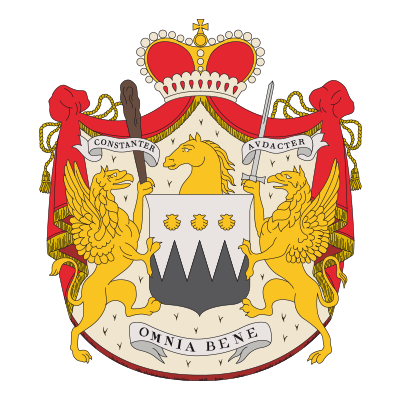
To understand the coat of arms of the Ruffo family, only a few elements need to be known.
The two colors — silver (upper half of the shield) and black (lower half) — correspond in heraldic language respectively to metal and enamel.
It is worth noting that black enamel is extremely rare in Italian heraldry, which has led some scholars to suggest that the Ruffo coat of arms may date back as far as Roman times.
The three shells arranged horizontally across the shield, known in heraldic terminology as orecchiate, are believed to have been introduced during the time of the Crusades. They symbolize the participation of knights of the Ruffo family in the first three Crusades.
The shell itself is an ancient symbol of pilgrimage. When depicted without “ears,” it represents Saint Michael. When depicted with the ears showing the inner surface, it represents Saint James of Compostela (Santiago de Compostela).
The shells were added to the Ruffo coat of arms in 1253, when Fulcone Ruffo, by marrying Margherita of Pavia, regained — after nearly a century — possession of the ancient fief of Sinopoli, which had long belonged to his family.
It had been the lords of Sinopoli who took part in the early Crusades, and the shells were intended to commemorate this participation.
The addition of these symbols served two purposes. First, it allowed the House of Sinopoli to be immediately distinguished from the senior Catanzaro line, which bore the same coat of arms but without the shells. Second, it emphasized the antiquity and prestige of the younger branch, which had once again become the lords of Sinopoli.
At that time the head of the family was Pietro I, Count of Catanzaro, the grandfather of Fulcone, who evidently approved his grandson’s choice.
Within the Ruffo family it has long been believed — though without documentary proof but supported by oral tradition — that Fulcone merely adopted the coat of arms with the three shells used by the ancient Lords of Sinopoli, whose line had died out during the reign of William I of Sicily, known as “the Bad.”
The crest is common to all the branches of the Ruffo family, although over the centuries it has been represented in two different forms.
In one version it appears simply as the head and neck of a horse. In the other — which is considered the correct and original representation — it appears as a horse emerging, showing the head, neck, and forelegs, similar to a foal at the moment of birth.
This latter form has a precise symbolic meaning, whereas the simpler version developed later because it was easier to draw.
The crest was added to the Ruffo coat of arms during the fourth decade of the thirteenth century, and it almost certainly received the approval of Emperor Frederick II, who was known to be intolerant of initiatives taken independently by his vassals.
The origin of the crest is connected with an important scientific development of the time.
During the 1240–1250 decade, Giordano Ruffo of Calabria, the younger son of Pietro I and master of the imperial stables, wrote a treatise on veterinary medicine. The work greatly impressed Frederick II, who was himself deeply interested in the natural sciences.
In this treatise — one of the earliest scientific works on veterinary medicine — Giordano Ruffo not only provided a systematic medical approach to the care of horses, but also described for the first time the technique of shoeing a horse’s hooves.
This innovation had enormous importance. It improved both military effectiveness and the speed and reliability of travel and communication. With horseshoes, horses could run safely across difficult terrain without damaging their hooves.
In an age when horses often became useless after battles or long journeys because their hooves cracked or split, the ability to protect the hoof with iron shoes represented a remarkable technological advance.
In recognition of this innovation, Emperor Frederick II granted the Ruffo family the right to add a crest to their coat of arms, representing precisely a “horse emerging.”
Toward the end of the first half of the fifteenth century, the line of the Counts of Catanzaro and Marquesses of Cotrone reached the height of its power under Nicolò Ruffo.
He served as Viceroy, Justiciar of the Calabrias, and lord of more than forty castles. At that time his lordship was the most powerful and wealthy in the Kingdom of Naples.
The Catanzaro line eventually became extinct through Enrichetta, daughter of Nicolò, who brought the inheritance into the Centelles-Ventimiglia family.
A remarkable seal dating from 1401 survives from the time of Nicolò Ruffo. The inscription reads:
S. ILLUSTRIS D.NI NICOLAI RUFFI DE CALABRIA
MARCHIO COTRONI
D.G. COMES CATANZARI
This inscription reveals something interesting: Nicolò acknowledged himself as a vassal of the king only in his capacity as Marquess of Cotrone. As Count of Catanzaro, however, he claimed the title “by the Grace of God,” implying a form of sovereign authority.
Even more remarkable is the use of the word ILLUSTRIS. At the time this title was normally reserved exclusively for the Duke of Calabria, heir to the throne.
During those years King Ladislaus of the Angevin-Durazzo line ruled Naples, and Nicolò Ruffo had frequent conflicts with him.
During the course of the fifteenth century, several cadet branches of the Catanzaro line also became extinct. These included the lines of the Counts of Montalto, the Counts of Altomonte, and the Lords of Badolato. These branches had added further prestige to the Ruffo house through marriages with royal families and by holding the most prestigious offices in the kingdom.
By the end of the fifteenth century, the only surviving line representing the Magna Domus of the Ruffo was the line descending from Fulcone I of Sinopoli, which until that time had constituted the second branch of the Ruffo di Calabria family.
Fulcone I Ruffo of Calabria, born in Tropea to Ruggero Ruffo and Belladama around the years 1231–1233, served as a page at the court of Emperor Frederick II during the fourth decade of the thirteenth century.
He was greatly esteemed by the Emperor, who in 1247 knighted him and granted him the fiefs of Santa Cristina and Placanica, which had previously belonged to the philosopher Master Theodore, a member of the imperial court.
Fulcone was present at the death of Frederick II and, together with his uncle Sigerio, who served as Master Marshal of the Kingdom, signed the Emperor’s testament. He also accompanied the body of the sovereign to Palermo.
He was not only a brave knight, but also a poet. One of his songs has survived and was later recorded by the scholar Torraca. At the same time he proved to be an able military leader.
From his fortified castles of Bovalino and Santa Cristina, which guarded respectively the eastern and western approaches to the only military road linking the Ionian and Tyrrhenian coasts, he resisted for more than two years the forces sent against him by Manfred, who had usurped the throne.
Fulcone thus became the last stronghold defending the legitimate rights of Conradin, the young heir to the Kingdom of Sicily.
A young man of extraordinary courage and character, Fulcone was praised even by Jamsilla, a chronicler otherwise strongly hostile to the Ruffo family. In the wars fought in Sicily and Calabria, alongside his grandfather Pietro I, he demonstrated both his bravery and his remarkable military skill.
The figure of Fulcone stands out almost alone in that unfortunate campaign. One historian of the nineteenth century even suggested that, had the conduct of the war been entrusted entirely to Fulcone, the outcome might well have been different.
The exact year of Fulcone’s death remains uncertain. In 1256, he was still defending the castle of Bovalino against the army sent by Manfred. Yet in a document dated 1266, Charles I of Anjou restored certain fiefs to Enrico, Fulcone’s eldest son, and to Margherita, Fulcone’s widow. It is therefore likely that Fulcone died in 1256, perhaps in Bovalino itself.
Because father and son bore the same name, later historians sometimes confused Fulcone I with Fulcone II. Some therefore mistakenly claimed that Fulcone I died in 1276 in a duel with Simon de Montfort, whereas in reality that duel involved Fulcone II, who was barely twenty years old.
The Sinopoli branch soon divided into two separate lines.
In 1332, after the death of Pierino Ruffo without heirs, the feudal inheritance was disputed between his uncles: Fulcone III, lord of Bovalino, Bruzzano and Policoro, and Guglielmo I, lord of Pietracicala and Artiscolo.
Although he was the younger brother, Guglielmo I obtained the State of Sinopoli, and in 1334 King Robert of Anjou granted him the title of Count.
The first Bovalino branch came to an end in 1372 with Nicolò Ruffo, son of Fulcone III. In his will he named as heir a relative of the same name belonging to the Catanzaro branch, thus transferring the inheritance to another line of the family.
With the sons of Count Guglielmo I, the Sinopoli line divided again into three branches.
1. Fulcone IV, who succeeded his father as Count of Sinopoli.
2. Enrico, who died young but left a son, Antonello, who founded the branch of Condoianni.
3. Ruggero Ruffo, who followed Queen Joanna I of Anjou to Provence and became the founder of the Ruffo of Bonneval.
The Bonneval branch brought great distinction to the family first in France and later in Belgium.
Over the centuries this line produced high-ranking prelates, generals and admirals of the French armed forces, distinguished Knights of the Order of Saint John of Jerusalem, and important figures in politics and public administration.
They formed marital alliances with some of the most distinguished noble families of France, where they remained until the time of the French Revolution.
During their residence in Provence, the Ruffo obtained the fiefs of Lamanon, Aurons, and Beauvazet. They also acquired the County of Bonneval, the County of La Ric, and the Marquisate of La Fare.
Today the descendants of this branch live in Belgium.
Around 1524, when the Condoianni branch became extinct, the surviving representation of the Ruffo di Calabria family remained with the descendants of Fulcone IV, second Count of Sinopoli.
From this line, in 1464, a new branch separated under Esaù Ruffo, which would eventually give rise to the Line of the Dukes of Bagnara.
From the Bagnara branch several important lines soon emerged. These included the Princes of Scaletta, established in 1673; the Princes of Castelcicala, created in 1719; and the Dukes of Baranello and Princes of Motta San Giovanni, created in 1725.
From the Scaletta line, another branch later separated in 1745, forming the Dukes Ruffo, Princes of Floresta, which eventually became the principal branch of the family.
The coat of arms of the House of Ruffo is extremely ancient. The earliest documented use of the arms by members of the family dates to the time of Pietro I Ruffo, in the thirteenth century, though the heraldic design is certainly older.
The historian Della Marra, drawing on the chronicle of an anonymous writer from the time of Manfred, recounts that the citizens of Messina, welcoming Pietro I, Count of Catanzaro, on his return to the city, waved black-and-white banners — the same colors that have always represented the Ruffo family.
In heraldic language the Ruffo coat of arms is described as: “Divided and indented silver and black. Crest: a horse’s head and neck emerging in black.”
The different branches of the Ruffo family adopted several mottoes over the centuries: Omnia Bene, Nobilissima et Vetustissima, Vis Unita Fortior, and Nunquam Retrorsum.
Because it would be impossible to describe all the members of the Ruffo family who distinguished themselves over the last five centuries, only a few figures may be mentioned.
Paolo Ruffo, who died in Scilla after 1561, restored the economic and feudal strength of his family after it had been greatly weakened during the Second Conspiracy of the Barons. A courageous military commander, he defeated the Ottoman leader Aricodemo Barbarossa in the Battle of Reggio in 1533, preventing an enemy landing along that coast. In 1535 he hosted Emperor Charles V, returning from the African campaign, in a specially constructed pavilion on the plains of Aspromonte.
Carlo Ruffo, son of Count Paolo, became a Knight of the Order of Saint John of Jerusalem and won great renown during the Great Siege of Malta in 1565. After successfully repelling repeated Turkish assaults, he was killed at the age of 33 by a cannon shot in August 1565. The defensive position he had commanded thereafter became known as the “Post of Fra Carlo Ruffo.”
Giovanna Ruffo, daughter of Fabrizio, Prince of Scilla, was born in 1593. Beloved by the people of Scilla, she embellished the town with monumental fountains, churches, and convents, all of which she richly endowed. She also founded a hospital, where the poor could receive free shelter and medical care, and established a conservatory for orphaned girls of modest means living within her territories.
Luigi Ruffo, born in 1750, pursued an ecclesiastical career. In 1785, Pope Pius VI appointed him Archbishop of Apamea and Apostolic Nuncio to Florence, and in 1795 he was transferred to the nunciature in Vienna. In 1801, Pope Pius VII elevated him to the College of Cardinals, and the following year he was appointed Archbishop of Naples. He suffered persecution under Napoleon, and when he refused to celebrate Napoleon’s marriage to Maria Christina of Austria, he was confined in Saint-Quentin in northern France. He died in Naples on 16 November 1832.
Fulco Giordano Antonio Ruffo, born in Scilla in 1773, enjoyed a brilliant diplomatic career, holding several delicate and prestigious assignments. As Ambassador to Spain, in 1824 he negotiated the marriage between King Ferdinand VII of Spain and Maria Christina of Bourbon, Princess of Naples. Some years later he was entrusted with a similar task in arranging the marriage between King Ferdinand II of the Two Sicilies and Princess Maria Cristina of Savoy. In 1844 he served as Minister of Foreign Affairs of the Kingdom of Naples.
Fulco Luigi Ruffo, born in Palermo in 1840, also entered the Church. He became Archbishop of Chieti, later Apostolic Nuncio in Bavaria, and in 1891 he was elevated to the College of Cardinals with the title of Santa Maria in Traspontina.
Caterina Ruffo, daughter of Carlo I, Duke of Bagnara, founded in Naples in 1611 the Monastery of San Giuseppe dei Ruffo. She also established an important chapel in the church of the Fathers of the Oratory, known as the Gerolamini. This chapel is considered the most sumptuous within that monumental church. Dedicated to the Nativity of Our Lord Jesus Christ, it is entirely constructed in finely carved white marble and decorated with ten columns and six statues created by Pietro Bernini, father of Gian Lorenzo Bernini.
Antonio Ruffo, brother of Caterina, was born in Bagnara in 1610, the posthumous son of Duke Carlo. Through careful management and entrepreneurial ventures he increased the revenues of his estates and assembled one of the most important art collections in the Kingdom of Naples, containing 364 paintings by masters such as Bruegel, Dürer, Artemisia Gentileschi, Guercino, Mattia Preti, Rembrandt, Ribera, Tintoretto, and Titian. He also collected tapestries and silverware of the highest quality. Antonio Ruffo became the founder of the lines of the Princes of Scaletta and the Princes of Floresta.
Fabrizio Ruffo, son of Francesco II, Duke of Bagnara, was born in 1619 and died in Naples in 1692. He was one of the most celebrated captains of his age. In the Sovereign Military Order of Malta he rose to become Prior of Bagnara, Grand Prior of Capua, and Captain General of the Fleet. He played an important role in the War of Candia and in defending Christian fleets against Ottoman attack. During the revolt of Masaniello in Naples, he also distinguished himself as a man of peace and moderation. He created a family trust whose provisions helped preserve Ruffo estates in Calabria for generations. He was buried in the Church of San Giuseppe dei Ruffo in Naples.
Tommaso Ruffo, born in Naples in 1663 and dead in Rome in 1753, pursued a distinguished ecclesiastical career. While still young he served as Internuncio in Brussels. He later became Apostolic Nuncio in Tuscany and Madrid. After being appointed Archbishop of Naples, he was elevated to the College of Cardinals in 1706 and sent as Papal Legate to Ravenna and Ferrara, eventually becoming Archbishop of Ferrara. Later he returned to Rome, where he became Dean of the College of Cardinals.
He left behind a reputation as a charitable and benevolent man and an exemplary church leader. At his court in Rome served as auditor the prelate Giovanni Angelo Braschi, who would later ascend to the papal throne as Pope Pius VI.
Cardinal Tommaso Ruffo also established a family ecclesiastical benefice reserved for clerics belonging to the houses of Bagnara, Scaletta, Castelcicala, and Baranello. Among those educated at his court was one of his great-nephews, Fabrizio Ruffo, the son of Letterio Ruffo, Duke of Baranello, and Giustiniana Colonna, Princess of Spinoso and Duchess of Guardia Perticara.
This Fabrizio Ruffo would later become the famous Cardinal who in 1799 raised and led the Sanfedist army, restoring the Bourbon monarchy in the Kingdom of Naples.
Cardinal Fabrizio Ruffo, a member of the Order of Deacons, is one of the most famous figures in the history of the family. Many conflicting and often inaccurate interpretations have been written about him. More recent historians, however, have sought to reexamine his role with greater objectivity.
Among later members of the family was Fabrizio Ruffo, born in 1763 and deceased in Paris in 1832, Second Prince of Castelcicala, Duke of the House, and first Duke of Calvello. A distinguished diplomat, he served as Minister Plenipotentiary in Lisbon and London, later returning to Naples as Minister Secretary of State and again serving abroad as Ambassador in Paris. He also participated in the diplomatic negotiations that led to the Treaty of Vienna.
His son Paolo Ruffo, born in London in 1791, was educated at Eton and later fought at Waterloo, where he was wounded and decorated. He eventually reached the rank of Lieutenant General in the Neapolitan army.
Alvaro Ruffo, of the Princes of Scaletta branch, was born in Messina in 1754 and died in Vienna in 1825. He served as Minister Plenipotentiary to Portugal, France, and Austria, helped draft the Treaty of 1815, was granted the title of Prince, and later served as President of the Council of Ministers and Minister of Foreign Affairs.
Vincenzo Ruffo, Prince of Floresta and Duke of the House, was born in Messina in 1857 and died in Patti in 1918. A man of wide culture, he was a historian and art scholar whose monograph on the Ruffo Gallery in Messina was praised by the historian Corrado Ricci. He remains one of the most knowledgeable historians and biographers of his family.
Rufo Vincenzo Ruffo, Prince of Scaletta, born in Rome in 1888 and dead there in 1959, was a Bailiff Grand Cross of Honour and Devotion of the Sovereign Military Order of Malta and an officer in the Italian Air Force during the First World War. He earned degrees in law and philosophy, studied Hebrew and Arabic, and later played a political role in the Italian Popular Party alongside Don Luigi Sturzo and Alcide De Gasperi. He also sheltered anti-Fascist figures during the Fascist regime and later served in important public offices after the Second World War.
Although members of the Ruffo family had long served in the government of the Kingdom of Naples, they were not absent from the movements that led to the Italian Risorgimento.
Flavio Ruffo, born in Messina in 1802 and deceased there in 1832, was an ardent patriot and active member of the Carbonari. He was arrested in 1828 and condemned for conspiracy against the state, but his mother eventually obtained a royal pardon.
Francesco Antonio Ruffo, known as Gaetano, was born in Bovalino on 14 November 1822. He was tried for conspiracy against the state and sentenced to death. The sentence was carried out in Gerace on 2 October 1847. He is remembered as one of the “Five Martyrs of Gerace.” Before his execution he recited verses by Walter Scott inspired by the ancient sarcophagus of his ancestor Nicolò Ruffo in the Church of San Francesco.
From the historical survey presented above, beginning with Fulcone I, founder in the thirteenth century of the Sinopoli branch of the Ruffo di Calabria, four principal lines of the family have survived into the modern era:
• the Ruffo di Calabria
• the Ruffo della Scaletta
• the Ruffo della Floresta
• the Ruffo Counts of Bonneval and Marquesses of La Fare
The lines of the Dukes of Bagnara, the Princes of Castelcicala, and several other cadet branches became extinct in the male line during the twentieth century.
The final figure mentioned in this historical survey is Fulco Beniamino Ruffo di Calabria, who served as Mayor of Naples for more than ten years.
From his marriage with the Belgian noblewoman Donna Laura Mosselman du Chenois was born, on 14 August 1884, Don Fulco, IX Duke of Guardia Lombarda, XVII Count of Sinopoli, and Prince of the House.
A hero of the First World War, he succeeded Francesco Baracca in the command of the famous “Prancing Horse Squadron.” For his bravery he was awarded the Gold Medal for Military Valor, two Silver Medals, four Bronze Medals, and was made a Knight of the Military Order of Savoy. Among the public, who followed his daring aviation exploits in the newspapers of the time, Fulco Ruffo di Calabria became known as the “Knight of the Sky.”
On 6 February 1918, at the Padua airfield, King Albert I of Belgium pinned the Cross of Leopold I on the chest of the man who, forty years later, would become the father-in-law of his grandson.
Fulco Ruffo later held important public positions and became a Senator of the Kingdom of Italy, serving as Quaestor of the Senate. He died suddenly in 1948 at Marina di Massa. From his marriage with the Piedmontese noblewoman Donna Luisa Gazzelli, Countess of Rossana, was born in 1937 his youngest daughter Donna Paola — who, just as her ancestors Berenice and Jole Ruffo had done a thousand years earlier, would be invested with royal dignity as Queen of the Belgians.