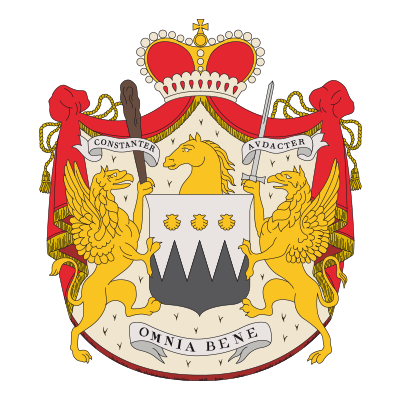

Giordano Ruffo di Calabria, second son of Pietro I (1188–1257), Count of Catanzaro and Viceroy of Sicily and Calabria, was most likely born in Tropea around the year 1188.
His brothers were Ruggero (1209–1236), father of Count Pietro II (1231–1309); Serio (also called Sigerio), Imperial Grand Marshal, who signed as witness—together with his nephew Fulcone (1232–1256/66)—the testament of Frederick II; and a sister, Adriana, who married Count Guglielmo di Borrello.
Giordano was a knight greatly esteemed by the Emperor, from whom he received high honors and the office of Master of the Knights.
In 1240 he served as castellan of Cassino. He was also Lord in Val di Crati and in the territory known as Terra di Giordano, named after him. His death occurred between 1253 and 1254, since after that year his name no longer appears in the chronicles of the period.
The Giordano who in 1255 took part in the war between Count Pietro I of Catanzaro and Manfred was a different person. He was in fact the son of Ruggero and Belladama, and therefore a nephew ex fratre of the Giordano discussed here. Since Giordano left no direct descendants, upon his death his domain passed—under the name “State of the late Giordano”—to his father Pietro I, Count of Catanzaro, who at that time was Grand Marshal of the Kingdom of Sicily, guardian of King Henry, still a child, and Vice-Bailiff of Sicily and Calabria.
Giordano was the author of a treatise on veterinary medicine, De medicina equorum, completed in 1250, which greatly pleased Emperor Frederick II, himself the author of a celebrated treatise on falconry, De arte venandi cum avibus, to whose compilation Giordano had also actively contributed.
The treatise written by Giordano, one of the earliest surviving examples of the Sicilian vernacular, begins, according to Del Prato, with the following passage:
“Incipit liber Manescalchiae. Nui Messere Jordano Russu de Calabria volimo insegnari a chelli chi avinu a nutricari cavalli secundu chi avimu imparatu nela Manestalla de lu Imperaturi Federicu chi avimu provatu e avimu complita questa opira ne lu Nomu di Deu e di Santu Aloi.”
Vincenzo Ruffo della Floresta, in his book Pietro Ruffo di Calabria, Count of Catanzaro, reports that a manuscript of this work exists, translated into French, in the library of San Giovanni a Carbonara in Naples; a second manuscript in the Damiani Library of Venice; and a third in the British Museum.
Hoping to examine at least one of these manuscripts—many of which have been mentioned but none of which anyone in modern times has claimed to have read—I undertook research that allowed me to obtain copies of the most reliable manuscripts currently preserved in Italy and abroad, in both public archives and private collections.
The library mistakenly referred to as Damiani in Vincenzo Ruffo’s book is in fact the Biblioteca Nazionale Marciana. The manuscript of De medicina equorum is preserved there under the shelf mark Lat. 7°, 24 (3677). It belongs to the eighteenth-century collection of Giacomo Nani and was printed in Padua in 1818, in Latin, by the veterinary physician Hieronymus Molin.
From a purely scientific perspective, this is the most valuable edition known today.
At The British Library there exist five printed volumes deriving from two different traditions. The first, translated from Latin into the vernacular by Fra Gabriele Bruno, had three editions: Venice 1492, Venice 1554, and Brescia 1611. The second had only two editions: Venice 1561 (printed by Rutilio Borgominiero) and Bologna 1561 (printed by Giovanni De Rossi).
In the same library there is also a sixth volume in Latin (Hieronymus Molin, Padua 1818), which corresponds to the edition derived from the manuscript preserved in the Marciana Library of Venice.
The study of these texts has enabled me to identify an inconceivable error committed by men of culture such as Fra Gabriele Bruno and Giovanni De Rossi. This error appears in three of these editions: Venice 1554, Brescia 1611, and Padua 1818.
The mistake consists in having confused Emperor Frederick II with his grandfather Frederick I Barbarossa. In the Latin edition of 1818, published by the Faculty of Veterinary Medicine of the University of Padua, this error was clearly noted by the editor of the work.
My mentioning it here serves only to conclude that the three volumes cited indeed represent references—produced in different periods by different editors—ultimately traceable to a single Latin original, which was translated into the vernacular on 17 December 1492 by “Gabriele Bruno, Venetian friar of the Minorites and Master of Theology,” and dedicated to Count Zoano Brandolino, a Venetian condottiere.
At the end of the book by Gabriele Bruno there appears a sonnet, in which he refers to “Messer Jordano Cavaliere” and to his treatise on farriery. This sonnet concludes the Venetian edition of 1554, printed by the heirs of Gioanne Padoano.
The other two editions (Venice 1561 and Bologna 1561) refer to a manuscript then owned by Messer Bartholomeo Canobio. Regarding this vernacular manuscript Giovanni De Rossi wrote:
“I wished to print it in the very language in which the Author wrote it.”
However, this version of the book of Messer Jordano of Calabria also does not appear to derive directly from the original. I am inclined to believe that the work was originally written in Latin (as was the contemporary treatise on falconry by the Emperor) and then immediately translated by others into the vernacular, in order to facilitate its dissemination in less learned environments, such as stables.
In the various editions, moreover, there are clear and evident alterations to the original text, with additions often of little or no scientific value, and sometimes even omissions of entire chapters.
For many centuries Giordano’s treatise remained the principal reference for anyone writing on the subject. It can be said that there was scarcely an author or editor—both in Italy and abroad—who did not introduce additions or mutilations to the original text, or who did not publish it under his own name or reproduce large parts of it without citing the source.
Quite recently, during a stay at Villa Cicero, residence of Donna Lucilla Ruffo della Floresta, I was able to examine an ancient treatise on farriery composed of three works: the first by the Neapolitan Federico Grisone, published in 1561; the second by various authors, published in 1559; and the third by Giordano Ruffo, which is the edition I am about to reproduce.
The existence of this book had been unknown to me, yet I was not surprised to find it in the library of direct descendants of Duke Vincenzo Ruffo della Floresta, who was—and remains—the most serious and thoroughly documented scholar of the history and genealogy of his lineage.
The Venetian edition of 1561, although altered and incomplete, seems to me the most suitable to be presented to the Ruffo living at the end of this millennium, just as at its beginning Giordano and other members of his house, following the path traced in history by other Ruffo—a lineage said to reach back three thousand years—
maintained the illustrious name of the “gens Rufa,” whose house, called Magna Domus by contemporaries, played a major role in the history of Calabria and Sicily.“Haec familia quinquaginta principes habuit et cum eis magnum multitudinem discendentium ad numerum termilium.”
(Ritonio, 15th century)