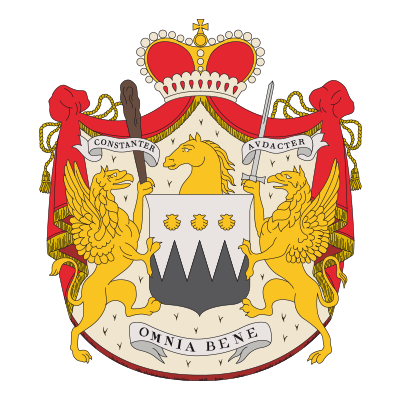

Summary Notes on the Ruffo di Calabria Family
Written by Giovanni Ruffo
For the Ionian Territorial Library System
Preface
Providing documented information on the genealogy of the Ruffo family, defined at the dawn of the second millennium as the Magna Domus, was for me neither a simple nor an easy undertaking, although I was greatly helped by the writings of Gioacchino Ruffo della Floresta and Vincenzo Ruffo della Floresta, who, with great documentary precision, wrote during the first two decades of the twentieth century.
When I accepted the invitation extended to me by the Director of the Ionian Territorial Library System, Dr. Piero Leone, to give him what I had written on the genealogy of the Ruffo family, I immediately realized that the 337 pages making up the still unpublished volume were too many, difficult to consult, and of limited interest for the ordinary Internet navigator. I therefore decided to summarize the genealogical information in a few pages, dividing it, for ease of consultation, into two distinct chapters: the first, in which I report information on the origin of this House, drawn from ancient texts and therefore poor in what may be called “direct” documentation, but accompanied by bibliographical references; and the second, in which I present amply documented information.
The first chapter begins with the notices given by Tamusio Tinga, who wrote that this family originated from Ascanius Silvius, son of Aeneas, King of the Latins, and specifically from Rufus, his third-born son; we are thus in the year 1191 B.C. (ante Christum natum: before the birth of Christ). The second chapter is rooted in the year 1146 of the Common Era and begins from a diploma of the first Norman king, Roger II, who invested Gervasio Ruffo, a cadet of the Ruffo di Calabria, with the fiefs of Cambuca and Minzillicar, located in the territory of Sciacca. A great-nephew of his, bearing the same name, appears among the imperial pages in a document of 1225.
CHAPTER I
According to the most ancient sources, the RUFFO family derives its origin from the Familia Rufa of Rome, descended from the Cornelia line. Many historians and genealogists who lived in past centuries wrote of the descent of this family. Giovanni Ritonio wrote of it in his work Texera omnium familiarum nobilium Italiae, published in Valencia in 1484, in which he states that at the time of the Empress Jole — daughter of Giovanni Fulcone Ruffo (in the chronicles of the period there is another Giovanni Fulcone, father of another Empress named Berenice) and wife of the emperor Andronicus John Comnenus — “haec familia quinquaginta principes habuit et cum eis magnam multitudinem discendentium ad numerum termilium.” In this regard, I think it useful to note that at the time of that emperor the Ruffo had already been present and powerful in Calabria for centuries, as will be documented in Chapter II.
Leone Marsicano (1046–1117), Cardinal and Bishop of Ostia — better known as Leo of Ostia — who wrote his Chronica Cassinensis between 1086 and 1105, states in the second volume that Filippo and Enrico Ruffo fought for the Normans also against the Greeks, and that in 1091 (1071? editor’s note) they received in their fiefs, as an ally, Robert Duke of Apulia and helped him conquer Terra d’Otranto and Basilicata. These two brothers are also indicated with the territorial designation of Catanzaro.
Fra Simone da Lentini, who lived in the time of the reign of the first Angevin, that is, in the second half of the thirteenth century, also wrote of the family. Fra Simone wrote: “Rufa, nobilissima et vetustissima familia tempore romanae republicae magnopere vixit et usque ad meum tempus potentissima vivit.”
Count Bernardo Candida Gonzaga, considered by all one of the great genealogists, wrote of the Ruffo family in volume five of his work Memorie delle famiglie nobili delle province meridionali d’Italia as follows:
“The opinions concerning the origin of this House, remembered by writers with the title of Great House, are unfounded or contrary to the documents. Contarino said it came from France with Charles I of Anjou, whereas Pietro Ruffo is found to have been a powerful lord in Calabria before the coming of the Normans: he was later Count of Catanzaro and styled himself Dei gratia Comes Catanzarii. In that age the House of Ruffo is seen to have reached the height of its power, so much so that around the year 1014 it gave valuable aid to the Greek Emperor in the reconquest he made of Calabria and Apulia against the Saracens, who had seized them. Gamurrini wished it to have originated from Assisi and then passed to Rome, from where it spread into various cities of Italy. Others believe it to have been Lombard. The greater part of the authors, however, say it originated from the Rufa people of Rome, descended from the Cornelia.”
For the sake of completeness I shall cite only the names of some other historians and genealogists who wrote on the same subject: Geronimo Enningens of Luneburg in his Teatro genealogico; Tamusio Tinga, already mentioned; Valerio Anziate in De proheminentia Romanae Reipublicae; Ubbone Emmio, Dutch genealogist; Ferrante Della Marra in Discorsi delle famiglie nobili; Ugone Falcando in Historia de rebus gestis in Siciliae Regno; Imhoff in Genealogia viginti illustrium in Italia familiarum; and Filadelfo Mugnos in Teatro genealogico delle famiglie illustri.
Lastly I cite the author closest to our own time who, anonymously, wrote Istoria della casa dei Ruffo, published in Naples in 1873 at the Tipografia nel Reale Albergo dei Poveri. Everyone, however, knows the name of this anonymous author: Francesco Proto, Duke of Maddaloni. It seems useful to me to reproduce not his historical-genealogical notices — which derive the Ruffo House from the Roman patriciate — but rather his introduction to the reading of the book, in which he clarifies the concept of “perfect nobility,” that is, the meaning attributed in genealogy to the definition “family of ancient nobility.” I believe this will help the reader better understand the “genealogical language” used in the past, should I myself fall into the error of resorting to it in the pages that follow. Proto thus introduces his book:
“As everyone knows, a family is an order of descent which, drawing its origin from one person and extending through children, and from children to grandchildren, and thus, consequently, from grandchildren to great-grandchildren, constitutes a lineage, as the ancients would say or, to speak more clearly, a kindred, which from the renown of deeds done, or from wealth long possessed, or from lands lorded over for some generations, or from the antiquity of its forebears, is called noble. And this word nobile, as should well be remembered, derives from the word nosco, as if to say knowable, that is, known or to be known. Hence the Latins used to take this word, having regard to its first origin, both for what we vulgarly call noble by reason of lineage and for any thing whatsoever which was very well known and famous, even if wicked and evil. Two things, then, if one considers well, are principal in making nobility perfect: these are antiquity and splendor…”
But I am writing for the “Internet navigator,” usually of youthful age and nourished by modern culture, a consideration which suggests to me that I should give a current definition of the concept of “perfect nobility” and of “ancient noble family,” so as to show clearly, by contrast, the old and the new meaning.
Claudio Donati of the University of Milan writes: “In a more specific sense and in connection with European history from antiquity to the modern age, the term nobility means a particular juridical and social condition, often hereditary, linked to exclusive honors and privileges, and by extension the ensemble of individuals, families, and ‘bodies’ endowed with that privileged status.”
To make clearer the practice that once regulated the life and survival of a feudal family — survival linked to the transmission of ‘honors and exclusive privileges’ from one generation to another — I shall say that in such families special ‘rules’ prevailed.
In a feudal family the first two male children were considered ‘firstborn.’ If from the marriage of the elder brother only daughters were born, the first of these daughters would marry her cousin, that is, the eldest son of her father’s brother. In this way the extinction of the male line of the House was avoided.
Feudal inheritance and allodial inheritance (that is, property free from feudal obligations) were transmitted through the institutions of fideicommissum associated with that of primogeniture or majorat (to the second son there belonged a ‘military allowance’ securing him a life income). Beginning in the second half of the sixteenth century, these were the legal institutions that governed the hereditary transmission — even in perpetuum — of noble patrimonies, allowing family property to pass undivided to the firstborn male. As a consequence there derived the social, juridical, and economic inferiority of cadet sons and of all daughters. Cadets had various options: the military career, the career in knightly orders, entry into religious orders, or into the secular clergy.
Female children too, if not assigned a marriage dowry — very burdensome for the family — had a ‘monastic dowry,’ less burdensome. Through such a dowry the girls entered prestigious religious orders and almost always attained the highest dignities of the order (which, as may be understood, increased the ‘influence of the Family’).
It was inevitable that a particular understanding should arise between the feudal nobility and the ecclesiastical world, from which there was born the juridical institution known as lay patronage (giuspatronato laicale).
Of this institution Donati writes: “…Thus the foundation of a lay patronage represented for a noble family a true long-term economic investment, because it allowed the decent maintenance of a male of the family for several generations; one might conclude that a benefice of lay patronage was a kind of fideicommissum in favor of cadet sons.” I need only add that noble patrimonies consisted essentially of landed property. Any profit derived from commercial, industrial, or financial activity served to increase the allodial patrimony (and also, where possible and convenient, the feudal one) by purchasing new lands and, to a lesser degree, other immovable goods.
A brief parenthesis to mention the laws abolishing feudalism.
In the Kingdom of Naples the feudal institution was abolished by the abolition law of 2 August 1806, which reached practical application around 1810–12 during the government of Joachim Murat. In the other states of the peninsula this had happened earlier. Despite the ‘damage’ caused in the Kingdom of Naples, and particularly in Calabria, by the French domination, which lasted ten years — damage due in great part to the ignorance of the central government of the region’s economic and living conditions and of its populations and, consequently, to its failure to understand the troubles, including political ones, present in that territory — one cannot deny that the abolition of the feudal institution laid the foundations upon which to grow the economy and improve the living conditions of the popular masses. If this did not fully occur, it was not wholly the central government’s fault. The Calabrians who formed the class of the so-called galantuomini of bourgeois — but above all rural — extraction took every opportunity to enrich themselves, with the consequence, often verified, of compromising the possibilities of economic growth. Closing this parenthesis, I shall try to summarize in a modern expression, more suited to our own time, the concept once held of ‘nobility,’ especially since for some time it has no longer possessed juridical personality.
Today the concept of nobility, if one really wishes to use it to define the conduct of a given citizen, can only be linked to the personal qualities of the individual rather than to birth.
I think it appropriate now to report some brief information on the name RUFFO.
The name originated from the Latin adjective rufus, rufa, rufum, which in Italian translates as the adjective ‘red,’ that is, reddish-blond or fox-red. The surname Ruffo, therefore, was at first a nickname and as such an adjective. Roman surnames, in fact, originated from nicknames given to individuals either for their characteristic qualities, or for special virtues, or for some action worthy of note, or for services rendered to the Republic, or again for physical defects, etc. With time the original adjective became a surname and, as such, was handed down to descendants. The first Ruffo, in all probability, had reddish or tawny hair.
On the origin of surnames one might discourse at length, and it would be of genealogical and somewhat also historical interest; for we have seen that for this discipline perfect nobility is closely linked to the antiquity of the House, as well as to its splendor.
Besides Roman patrician origins, the Ruffo were also attributed Norman, Lombard, and even French origins. This was an error into which even able historians of our own time fell, and it may be easily explained: historians, so far as I know, have not personally conducted genealogical investigations — which require particular talent, mentality, and ‘training’ — and in their writings they always referred to what was reported by others. It would instead be appropriate for historians to hold in due account the importance of genealogy, which after geography, chronology, and diplomatics is the most useful auxiliary discipline of history.
I believe I have written enough on the various theories concerning the origin of this House. One could write much more, and it would not be without interest — in the unpublished typescript I discuss it in just over fifty pages — but it would certainly be tedious for those without a specific interest.
Let us now come to the designation MAGNA DOMUS and to the predicate DI CALABRIA, enjoyed by this family over the centuries.
Giovanni Ritonio held that, from the time when the Ruffo family ruled in Calabria in the Greek-Byzantine age (therefore before the arrival of the Normans), it was called Magna Domus. There was no agreement on this point either. It is certain, however, that the House of Ruffo was called Magna Domus as soon as that title came into use. In any case it already enjoyed that appellation in the thirteenth century, as may be observed from diplomas and writings of the period. The already cited Fra Simone da Lentini, Bishop of Syracuse, wrote of it. In the sixteenth century Ammirato also wrote that the Ruffo family had made itself most illustrious from the time of the Greeks through the aid it had given them in the reconquest of Calabria and Apulia, and Summonte, writing of the same family, affirmed that it ‘had been and was great in the Kingdom both for the dominion it had held over many castles in Calabria and also for its great antiquity.’ We have also read this in the chronicle of Cardinal Leo of Ostia.
To satisfy the most demanding readers, I shall report another statement by Summonte: ‘The House of Ruffo was numbered among the seven most ancient superior families of the Kingdom of Naples,’ which, listed in alphabetical order, were ‘Acquaviva, Celano, Evoli, Marzano, Molise, Ruffo, Sanseverino.’ When the Houses of Evoli, Marzano, and Molise became extinct, they were replaced by those of Aquino, Del Balzo, and Piccolomini. Finally, Alexandre Dumas also wished to speak on the matter, writing: ‘…there is an Italian proverb which, to indicate the foremost principles of nobility in the various countries, says: the Apostoli in Venice, the Bourbons in France, the Colonna in Rome, the Sanseverino in Naples, the Ruffo in Calabria.’ The same may be affirmed for the predicate di Calabria, which we find beside the names of various members of the House in documents concerning Ruffo who lived in the first century of the second millennium.
For completeness, one must still dwell on two other matters: the time when the title of Count of Catanzaro was granted to the Ruffo — a title certainly enjoyed by Pietro I in 1250 — and the family tradition of signing Dei gratia Comes Catanzari. Although the topic is of slight historical importance, in the past there was disagreement not so much among historians as among students of nobiliary matters. Some wrote that Pietro I was made Count by Conrad IV in 1252, others by Charles I of Anjou in 1265 (Pietro I had in that year already been dead for nine years), and still others that a Pietro of that House already enjoyed it in the Norman age. Today one may say that they were all right. Pietro I Ruffo di Calabria was invested with that title in 1252 by Emperor Conrad IV (perhaps not wrongly, some said it was a confirmation rather than an investiture), the same Pietro was reconfirmed in the title by Pope Innocent IV in October 1254, and finally his grandson Pietro II was invested with the County of Catanzaro by Charles I of Anjou in 1265. Another Pietro Ruffo, who was raised to the cardinalate by Pope Gelasius II in 1118, was called of Catanzaro.
Considering the slight historical importance of the matter, a simple consideration is enough: the Ruffo used the formula Dei Gratia Comes Catanzari at least in their privileges from the age of Frederick II and of the first Angevin, as can be read in many archival documents. In documents of 1250–52 they also used the formula Dei et Regia gratia. If they had had no right whatsoever to do so, would those sovereigns have validated Ruffo privileges in which, as Counts of Catanzaro, they did not declare themselves royal vassals? This suffices to justify those who trace that title back to Norman times or even earlier. The Byzantines did not have in the organization of the state either feudal tenure or noble titles; however, in their dominions of Calabria and Apulia — often occupied by force by the Saracens — among the dominant families the custom had taken hold of imitating the Lombards, and thus when the knight of a House reconquered with his own forces lands occupied by the Moors, he declared himself Count or Duke by the Grace of God, through which formula he affirmed direct and absolute dominion over that land acquired by right of conquest. Evidently this occurred in the age of the decline of Byzantine arms. The Ruffo, in fact, in the years between 1086 and 1105 fought alongside the Normans both against the Greeks and against the Moors.
To close the chapter it remains only to ascertain when and from where the Ruffo arrived in Calabria. On this topic whole volumes were written in the past, so full of tediousness and cavils that they persuade me to do no more than touch upon it.
The Ruffo had come to Constantinople from Rome in the time of Constantine the Great. They arrived in Calabria during the twenty years 870/890 (for some around 979) with a Giovanni Fulcone — a descendant of Marco Antonio Ruffo, general of Emperor Justinian II — whose daughter Berenice married Emperor Basil II (for others Basil I). This Giovanni Fulcone (we have already encountered another Ruffo of the same name), governor of Calabria Citra and Ultra, freed that province from Saracen domination. It is superfluous to add more on this point because, as I have already written, I shall publish a privilege of Roger II, first Norman king, dated Palermo, April 1146, in which one reads both whence the Ruffo arrived in Calabria and of their military power in the Calabria of that time. I ask myself: will this suffice to set, so to speak, a fixed point in the discussions on the descent of the Ruffo from the patriciate of Rome, on the title Magna Domus, on the appellation di Calabria, and finally on the Dei Gratia and Dei et Regia Gratia used over the centuries by the knights of that blood?
CHAPTER II
In the archive of the House of Ruffo di Calabria — that part which in April 1947 Luigi Ruffo di Calabria, Duke of Guardia Lombarda, entrusted for safekeeping to the State Archives of Naples — there exists a parchment (in copy) belonging to the series ‘Privileges.’ It is a privilege of King Roger, written in Greek with the Latin translation at its side, from April 1146, by which that king granted to Gervasio Ruffo, a cadet of the House of Calabria, the lands of ‘Minzillicar and Chambucas,’ situated in the territory of Sciacca.
This document, at least for the last fifty years, has been fairly well known not only to historians, but also to students or simple enthusiasts of historical studies. Everyone cites it, but certainly no one has ever read it, at least among those who have written on the genealogy of the House of Ruffo and on that period of our history. Had they read it, indeed, they would have had no need either to conjecture about the origin of the House or to refer — and even then not without perplexity and reserve — to ancient works in order to imagine the time of the arrival of the Ruffo in Calabria, their provenance, and the condition they had in that region before the settlement of the Normans.
Below I propose to reproduce the translation and the photographic copy of that part of the document which concerns the subject in question. I shall publish elsewhere in the present writing the entire document, to offer those interested — as is right — the possibility of reading it also in the original.
For the moment I keep my promise to report in translation and in copy that part of the privilege which concerns the foregoing discussion:
ROGER, BY THE GRACE OF CHRIST GOD PIOUS AND POWERFUL KING
In the month of April of the present seventh indiction. While we dwell serenely and for the glory of God exercise our power in the city of Palermo and, with God’s favor, dwell in this same palace, there comes before Our Majesty [Power] the faithful ally [companion] in arms (fidelis armorum socius), the stratiota (stratiotes), Lord (Dominus) Gervasio Ruffo, who makes request and supplication (postulans et supplicans) to have lands not only for the pasture of his animals but also for cultivation (pro aratio), therefore, so that he may have lands to cultivate, we give to you and to your men expert in such matters (preceptores) in the territory of Sciacca lands sufficient for your needs. […]
King Roger, therefore, by recalling the Byzantine military dignity (stratiota) of Gervasio Ruffo, certifies, so to speak, the origin of the Ruffo and the time of their arrival in Calabria. By defining him, moreover, as fidelis armorum socius, he gives us sure notice of the power reached in Calabria at that time by the Ruffo family.
To complete the matter — trusting in the patience and love for history of the navigators of the Internet — I reproduce what Duke Proto wrote on this subject; if it is not delightful reading, it serves to make clear and summarize a discourse otherwise very long and even more tedious to read:
“It was therefore in these times and amidst such most grievous vicissitudes, around the year one thousand of our salvation, that the Emperor of Constantinople, having lost, through invasions of Moors and of princes and counts of Lombard stock, almost all his possessions in Italy, with the aid of the Ruffi and the Giuliani recovered Calabria and Apulia. The greatest writer of those times and the most authoritative for the truth or verisimilitude of his narrations, Leo, monk of Montecassino, commonly called Leo of Ostia from his cardinalate and bishopric of Ostia, in the second book of that history of his, which out of modesty he entitled Cassinese Chronicle, speaks thus of the fact: ‘sed cum graecorum, qui paucis ante annis Apuliam sibi Calabriamque, sociatis sibi Ruffis atque Iulianis vendicaverunt insolentiam…’ Which these Giuliani were, who together with the Ruffi, according to Leo of Ostia, newly reduced the provinces of Calabria and Apulia to the obedience of the Byzantine Caesars, we can say neither much nor little. For no memory is found of these Giuliani, neither before nor after the year one thousand, in those parts of Italy, nor still less in the provinces facing them. It is undoubted that they, had they truly done what Cardinal Leo narrated, must have been almost equally or only slightly less powerful than the Ruffo family in that region, and for that reason they ought to have left greater memory of themselves. But perhaps the Giuliani were only a second branch of the Ruffi themselves… The word sociatis sounds in our vulgar speech as ally, confederate; and therefore one must surely admit that the Ruffo family was sovereign in southern Italy at that time, or there played the part of a sovereign… since if its princes had been merely barons, the Emperor of Constantinople would not have called them allies, but would have sent them as captains and vassals… Therefore, since lands and castles were undoubtedly possessed by the Ruffi in the Calabrias in the year one thousand and before it, undoubtedly too they held these lands and castles as absolute lords, as sovereigns, and not by useful dominion… And this consideration of ours should be well remembered, for it will splendidly explain that assumption of sovereign style later made by the Ruffo Counts of Catanzaro, who in their diplomas used the formula Dei gratia Comes…”
Thus wrote Duke Proto in the nineteenth century, to whom the privilege of King Roger II was not known.
I must confess that I cannot resist the temptation to complete Duke Proto’s discourse with some observations of my own on the diploma of King Roger II, which help to illustrate better the times and the ‘language,’ let us say, of caste then in use.
King Roger in his diploma expresses himself in two different ways regarding Gervasio Ruffo (whom we recall was a cadet of his House). When he receives Gervasio at court, as a member of the family allied with him in war (armorum socius), he treats him as an equal, indicating him with the military dignity of ‘Stratiota,’ defining him ‘fidelis’ and qualifying him ‘Dominus.’ With the concession of fiefs, Gervasio becomes a royal vassal and then he is postulans et supplicans, as all vassals were when addressing their lord. Gervasio is no longer fidelis armorum socius because the King is now his Lord and absolute Master, and as such commands the vassal, and for the vassal fidelity is no longer his choice: it is an obligation, a duty.
Here then, if there were any need, is reinforced Proto’s affirmation that the Ruffo di Calabria were at that time Lords by ‘Grace of God’ of their castles and not vassals of any monarch.
Having acquired these notions, the moment is ripe to discuss the genealogy of the Ruffo House.
I believe I shall be doing something useful and agreeable to the ‘navigators’ of this new ‘ethereal sea’ — at which, I confess, I look with perplexity and a certain mistrust; but I neither make the times nor shape opinion: I remain a citizen of the past millennium — I was saying that I believe I shall be doing something useful by limiting the genealogical notices to the historically documented period and to the best known and most indicative figures. At the end, for the more demanding and passionate navigators, I shall provide a genealogical tree extending a little more than a thousand years, but rigorously limited to the senior line, and I add that it would be my ambition to manage to do something other than produce a ‘telephone directory.’ From this point on, beside the names of the figures of whom I write, I shall indicate in parentheses the number that distinguishes them in the genealogical tree, so as to facilitate their identification.
Looking over this tree one will note that for the first figure, Giovanni Fulcone, and down to the sixth, Pietro di Calabria, Lord of Catanzaro, the names of the respective consorts are not given, because they are not known.
The historically documented period begins with (7) Giordano, who in 1186 married Agnese, his kinswoman.
Their son was (8) Pietro I, raised by Emperor Frederick II to the highest ranks of the military hierarchy and to the most important offices of government. On Pietro I historians and genealogists caused in every age great confusion, not distinguishing him from his grandson (ex avo) who bore the same name. As a consequence there was created the figure of a single Pietro Ruffo, protagonist of the greatest historical events, who had lived for more than one hundred years. The existence of two distinct figures of the same name had been noticed and documented by Don Vincenzo Ruffo della Floresta, but he was not a historian and received little credit. It was the merit of the great Calabrian, the eminent historian Ernesto Pontieri, to have shed light on the two distinct figures of the same name — (8) Pietro I (1188–1257) and (10) Pietro II (1230–1310), that is, grandfather and grandson — who lived, the first in the time of Emperor Frederick, and the second in the reign of Charles I and Charles II of Anjou. Pontieri wrote at least three volumes on Pietro I and his grandson: Pietro Ruffo di Calabria e la sua presunta fellonia; Un Capitano della guerra del Vespro: Pietro II Ruffo di Calabria; and Ricerche sulla crisi della Monarchia siciliana nel secolo XIII.
Pontieri himself did not conduct personal genealogical research on the figures about whom he wrote, relying on the studies of Francesco Scandone, who was not always precise and consequently created some confusions. I discuss this at length in my writing I Ruffo alla Corte di Federico II, to which I refer interested readers.
(8) Pietro I was a prudent statesman, most faithful to the House of Hohenstaufen and to the testamentary wishes of Frederick, even when Manfred, natural son of the deceased Emperor, usurped the Kingdom from his nephew Conradin. He was the most tenacious opponent of Manfred and, to obstruct his designs of usurpation, he, a Ghibelline, sought help and allied himself with the Pope. Defeated, he fled to Terracina in the Papal State, where in the first days of January 1257 he died treacherously stabbed by an assassin of Manfred.
His grandson, (10) Pietro II, was described as one of the greatest generals of his time. It was written that if the grandson had possessed the political acumen of the grandfather, and if the latter had possessed the same military capacities as the grandson, the events of that time would have taken a different course. This (10) Pietro II would continue the senior line of the Ruffo di Calabria, known as the Counts of Catanzaro.
Another grandson of (8) Pietro I was (1) Fulcone Ruffo di Calabria (1231–1256?). He is the founder and appears as number (1) in the junior line, which would succeed the senior line when the Ruffo of Catanzaro became extinct in the Centelles Ventimiglia in the second half of the fifteenth century. This same (1) Fulcone is the progenitor of all the contemporary Ruffo branches.
(1) Fulcone is also known by the name Folco and as the ‘poet of the Sicilian school.’ It is necessary to speak briefly of him, for although his life was short, he was a man who left a trace of himself because he possessed a lively intellect and military ability remembered by all.
It is indispensable, in order better to understand the man (1) Fulcone, to mention the personality of the Emperor and to describe the court environment in which the pages lived in close contact with the Emperor from the age of fourteen.
In my aforementioned article I Ruffo alla corte di Federico II, I thus wrote of the Emperor and the court environment:
“[…] His mother gave him the name Constantine, but in baptismo that name was changed to Federico Ruggero: the names of his forebears, the German Barbarossa and the Norman Roger II. As Emperor and King he was called Frederick II. His contemporaries defined him stupor mundi, wonder of the world, and immutator mirabilis, marvelous transformer. But stupor mundi, in the language of those times, also meant ‘overturning of the established order, generating fear and confusion’!…”
[The original Italian passage on Frederick II, Giovanni Villani, Fra Simone da Parma, Michele Amari, the imperial court, Pier delle Vigne, Michele Scoto, and the education of pages was reproduced here by Giovanni Ruffo from his earlier essay. Its full English translation was prepared separately in the chapter The Ruffo at the Court of Frederick II.]
Among these Ruffo there was (1) Fulcone, son of (9) Ruggero di Calabria and Belladama and therefore brother of (10) Pietro II and grandson of (8) Pietro I. Again from my cited writing I draw other notices on Fulcone and on the life at court of the pages:
“[…] As was the custom at that court, Fulcone began his career as an imperial page at the age of fourteen, that is, around 1243. He must have been endowed with particular intelligence and uncommon powers of learning if, while still very young, we find him not the least among the poets of that school. These qualities certainly drew upon him the attention and affection of Frederick II, who wanted him beside himself until his final day. Indeed, a few weeks before the death of the Emperor, he received from him in fief some possessions that had belonged to the court philosopher Master Theodore (although archival documents instead show that this investiture dates from 1247). Reckoning the dates, when the Emperor died Fulcone Ruffo must not yet have been twenty years old.”
Francesco Torraca, in his work Studi su la lirica italiana del duecento (Bologna, Zanichelli, 1902), at p. 127 writes: “Only one lyric by Messer Folco di Calabria has come down to us; but he occupies no small place in history. He resembles, in the one thing and in the other, Arrigo Testa. Nephew of Pietro Ruffo, Count of Catanzaro, cousin or brother of the knight Giordano Ruffo, author of the Liber Mascalciae, he assisted at the final moments of the great Emperor, whose testament he signed.”
“I think it is worth pausing to describe the court environment in which imperial pages lived and matured in life and learning. In the choice of pages or officials Frederick II gave no importance to birth, social origin, or color of skin, but personal gifts and qualities counted greatly. One example among many: Giovanni Moro, son of a Saracen slave woman, held an important place at court, formed part of the familia, and received a barony. As concerns the pages, very many among them were scions of knightly nobility, but even for them the power or wealth of the family from which they came had no influence on their career. The pages (among them were also the sons of Frederick II) lived in direct contact with the Emperor and received a courtly-chivalric education — made known to us by the poetry of the time — together with those teachings which, as adults, would make of these adolescents perfect state officials. The presence of a great number of nobles among the pages is explained by a particular circumstance: a noble could not become a knight unless he had first served as a page. Thus the scions of the kingdom’s nobility spent the years of youth at court and, as pages, entering the familia, received a monthly payment of six ounces of gold and the right to have in service three squires with their horses. The pages represented the lowest rung of the chivalric hierarchy and had a seneschal at their head. They had no precise duties: they were destined particularly to services of a ‘chivalric type’.”
“The pages ceased service at court when they had earned the knightly belt. They then went on, though still young, to occupy important administrative offices or to serve in the army or to return to their fiefs. Others were directed toward university studies. In every case, having taken part in court life gave them great prestige and opened many careers. The Emperor once wrote to the father of a page: ‘We have accumulated in him the rudiments of virtue, so that he might feel himself worthy of himself, useful to others, and profitable to us.’”
“In such an environment Fulcone Ruffo was educated. It is therefore no wonder that, perhaps not even eighteen years old, he was counted among the most appreciated poets and received even in very youthful age directly from the Emperor the investiture of knighthood and the possession of fiefs. The very important tasks that Fulcone had in the years 1251–52 also find justification, when in Istria he signed as witness to imperial grants and undertook to receive the new Emperor Conrad IV. In 1254 he was placed by his grandfather Pietro I at the head of the ambassadors sent to the Pope.”
“As a soldier he was praised even by the Anonymous chronicler — a detractor of the Ruffo House — when under the walls of Aidone he checked the impetus of the army that was about to overwhelm the troops under the command of his grandfather. And the same Anonymous could find only expressions of respect when he narrated how Fulcone, entrenched in his castles of Bovalino and Santa Cristina, held out for almost two years against the army of Manfred. In 1253 Fulcone married Margherita di Pavia, daughter of Messer Carnelevario, by whom he had the sons Enrico and Fulco II. The date and cause of his death are unknown, but in 1266 he certainly was no longer alive […].”
I fear I have written a little too much on Fulcone, but the figure required it.
His brother (10) Pietro II, to whom I referred above, was restored in 1266 by Charles I of Anjou to the fiefs and the title of Count of Catanzaro possessed by his grandfather (8) Pietro I. He married a lady of great house, Giovanna d’Aquino, by whom he had six children. (11) Giovanni continued the senior line, while another son named Giordano founded the branch of the Counts of Montalto, which won much renown in later centuries.
The line of the Counts of Catanzaro, Marquises of Cotrone, became extinct with (15) Enrichetta in the Centelles Ventimiglia in the second half of the fifteenth century.
This Enrichetta was the daughter of (14) Nicolò, of whom I shall give brief notices in the genealogical tree.
Genealogy of the Ruffo di Calabria
Direct senior line
1. Giovanni Fulcone, Byzantine general
2. Pietro, Lord of Calabria and Apulia (970)
3. Costanzo, Lord of Calabria
4. Pietro di Calabria, Lord of Catanzaro. He possessed the land of Catanzaro by right of conquest, whence the style ‘Dei gratia Comes Catanzari’ used in later centuries by his descendants.
5. Filippo di Calabria, Lord of Catanzaro. His grandson Pietro, son of his brother Giordano, was created cardinal by Pope Gelasius II in 1118.
6. Pietro di Calabria, Lord of Catanzaro
7. Giordano di Calabria. He married in 1186 Agnese, a lady of his own House.
8. Pietro I di Calabria (1188–1257), Count of Catanzaro. He married Guida, whose House is not known. He was Viceroy of Sicily and Calabria, Grand Marshal of the Kingdom of Sicily, and Guardian of Henry, youngest son of Emperor Frederick II.
9. Ruggero di Calabria, born in 1209. In 1229 he married Belladama. In 1235 he was President of the Kingdom of Sicily. He predeceased his father. He had five sons: Pietro (II), Fulcone (I), Giordano, Guglielmo, Giovanni.
10. Pietro II di Calabria, Count of Catanzaro (1230–1310). In 1254 he married Giovanna d’Aquino. In 1266 he was restored by Charles I of Anjou to the fiefs and title of his namesake grandfather. He fought strenuously for the first two Angevins.
11. Giovanni di Calabria, Count of Catanzaro, born 1255. He married Francesca di Licinardo. He was lord of a vast and powerful state rich in more than forty castles.
12. Pietro III di Calabria, Count of Catanzaro. He died in 1344. He married Sibilla di Reggio.
13. Antonello di Calabria, Count of Catanzaro, died in 1383.
14. Nicolò di Calabria, Count of Catanzaro and Marquis of Cotrone (October 1390), died 1445. Lord of a vast state, he had a very troubled life and changing fortunes under the two dynasties contending for the Kingdom. He married twice; the first wife, who died while they were refugees in Provence, is unknown by name; the second was Margherita di Poitiers, daughter of Ludovico, Sire of Saint-Valier, intimate of the House of Anjou. He had no male descendants. He was a fierce adversary of King Ladislaus despite having obtained from him the Marquisate of Cotrone.
15. Enrichetta di Calabria, Countess of Catanzaro and Marchioness of Cotrone. She married Count Antonio Centelles Ventimiglia of Calisano. Her life was troubled and tragic, for she lost her husband and her state because of the two conspiracies he plotted against the Aragonese dynasty. Her only male child died beheaded while prisoner of the Turks. With Enrichetta the senior line of the Counts of Catanzaro became extinct. The junior line of the Counts of Sinopoli then took over, which I begin from the common ancestor of the two lines, (9) Ruggero.
Direct junior line
9. (Ruggero di Calabria – Belladama, 1229) (see reference in the senior line)
1. Fulcone I, born 1231, died between 1256 and 1266. Lord of Sinopoli, Bovalino, Santa Cristina, Bruzzano, etc. He fought valiantly against Manfred. He was dear to Frederick II, who knighted him in 1247, investing him with the fiefs of Santa Cristina and Placanica. He signed the Emperor’s testament and accompanied the body to Palermo. He is also known as Folco, poet at the imperial court. In 1254 he married Margherita di Pavia, only daughter of Messer Carnelevario. He is head of the line of Sinopoli, which became the principal line after the extinction of the senior line of Catanzaro. From this knight descend all the Ruffo, divided into various branches, living at the end of the second millennium.
2. Enrico I di Calabria (1255–1321). He married Margherita di San Lucido. King Charles I of Anjou reinvested him with his father’s fiefs in 1266. He fought strenuously for the first two Angevins. He was Chamberlain of Charles II, Viceroy of Calabria, etc.
3. Guglielmo I di Calabria, 1st Count of Sinopoli in 1334. He married first Caterina Alemagna, second Eloisa d’Eroille de Barulo. King Robert, in granting him the title of Count over the land of Sinopoli, preferred him to his elder brother Fulcone III, lord of Bovalino and of a rich state. This became a cause of discord between the two brothers. The son of this Fulcone III, Nicolò (died 1372), whose sarcophagus can be seen in the Church of San Francesco in Gerace, named as heir his namesake from the first line of Catanzaro.
4. Enrico II di Calabria, 2nd Count of Sinopoli. After his premature death the county passed to his brother Fulcone IV rather than to his minor son Antonello. This Antonello would become founder of the branch of the Lords of Condoianni.
5. Fulcone IV di Calabria, died 1392, 3rd Count of Sinopoli. He married first Covella d’Alife, second Martuscella Caracciolo.
6. Guglielmo II di Calabria, died 1414, 4th Count of Sinopoli (1393). In 1381 he married Lucrezia Caracciolo, Countess of Gerace.
7. Carlo di Calabria, 5th Count of Sinopoli (1414). In 1449 he was Count of Gerace. Alfonso I of Aragon had created him Governor General of Calabria in 1444. He married first Caterina Grimaldi (1415), second Maria Centelles, sister of Antonio. Carlo took part in the two baronial conspiracies plotted by his brother-in-law, was declared a rebel, and had his state confiscated (1458). Born in 1382, he died at the age of 84 in 1466.
8. Giovanni di Calabria, 6th Count of Sinopoli, Count of Butera. He lived much of his life deprived of state and titles. Restored to the favor of King Ferrante, he regained the County of Sinopoli, that of Butera, and a good part of the old state. He married first Eleonora di Cardenas, attached to the House of Aragon; second Caterina Marchetti, died 1502; third Petruccella Cirino, by whom he had the children Paolo, Antonino, Violante, Albina, and Diana. He died in 1519. Paolo, not yet fifteen years old, was heir. Antonino married Beatrice Consolino, a lady of ancient house, giving rise to a cadet branch which, owing to the vicissitudes through which the House had passed and nearly disappeared under his grandfather Carlo, was enfeoffed but not titled. He lived at Terranova. His descendant Girolamo returned in 1545 to the land of Motta Bovalina, enjoying the lay patronage of the rich Abbey of Santa Maria di Pugliano and of those of San Nicola di Butramo and Santa Maria di Camocisse.
9. Paolo di Calabria, 7th Count of Sinopoli, 1st Lord of Scilla. He married Caterina Spinelli. With Paolo the House of the Ruffo di Sinopoli-Scilla takes shape, as senior line after the extinction of that of Catanzaro. He lived and acted so that his House might return to its ancient splendors, and he was supported in this by his relatives. His brother Antonino even renounced the military allowance due to him as second-born, living at Terranova as a small feudatory. In his testament Paolo cites him as an example to his son and heir Fabrizio. The descendants of this Antonino, still living, were enfeoffed but not titled. In 1535 Paolo hosted Emperor Charles V, returning from the African expedition, in a pavilion built for the occasion on the slopes of Aspromonte. In 1533 he purchased from Gutierre de Nava, husband of his sister Violante, the land of Scilla. He was a valiant commander. When in 1533 he was captain of arms at Reggio, Count Paolo repulsed the assault of the fierce Aricodemo Barbarossa, leader of the Turkish fleet, preventing his landing and the sack of Reggio and the towns of the coast.
10. Fabrizio di Calabria (1533–1587), 8th Count of Sinopoli, 1st Prince of Scilla (31 July 1578), President of the Kingdom of Sicily (1582). He married first Ippolita de Gennaro, Countess of Nicotera; second Isabella Acquaviva. By the first he had only Maria, who succeeded him; by the second only Margherita.
11. Maria di Calabria, 9th Count of Sinopoli, 2nd Princess of Scilla, Countess of Nicotera. She married her cousin Vincenzo, son of Marcello, brother of her father, and of Giovanna de Bonavides de Alarson. Vincenzo, maritali nomine, was invested with his wife’s titles and was also 1st Marquis of Licodia. In 1598 he assisted Reggio against the Turks. He died 3 June 1616. He had no male descendants.
12. Giovanna di Calabria, 10th Count of Sinopoli, 3rd Princess of Scilla, etc. In 1615 she married her cousin Vincenzo, son of her uncle Muzio (himself son of Marcello) and of Camilla Santapau. In second marriage (1634) she married Francesco Carafa, Duke of Nocera. She had no descendants from the second marriage. Vincenzo Ruffo di Calabria, maritali nomine, assumed the titles of his wife and on 21 May 1622 added the title of Prince of Palazzolo. He also added to his surname that of his mother Santapau, borne by his descendants. He died in 1632.
13. Francesco Maria di Calabria (1619–1704), 11th Count of Sinopoli, 4th Prince of Scilla, Count of Nicotera, Prince of Palazzolo, Marquis of Licodia. Unmarried. He was succeeded by his nephew Guglielmo, son of his brother Tiberio (1627–1683), who in 1666 had married Agata Branciforte.
14. Guglielmo III di Calabria (24 June 1672 – 4 November 1748), 12th Count of Sinopoli, 5th Prince of Scilla, Count of Nicotera, Prince of Palazzolo, Marquis of Licodia. He was lord of many fiefs. In 1724, together with his son Fulco Antonio, he was aggregated to the Seggio Capuano of Naples. On 14 June 1699 he married Silvia della Marra, Duchess of Guardia Lombarda. He added to his own titles that of his wife and became 1st Duke of Guardia Lombarda. This was the Prince of Scilla of whom Alexandre Dumas speaks in his Storia dei Borbone di Napoli.
15. Fulco Antonio I di Calabria, 13th Count of Sinopoli, 6th Prince of Scilla, Count of Nicotera, Prince of Palazzolo, Marquis of Licodia, Duke of Guardia Lombarda. He was born at Scilla on 22 April 1702. His life was very troubled, also because of endless lawsuits with the Università of Scilla. In 1719 he married first Teresa Tovar de Strada, daughter of the Marquis Pietro di San Marcellino; second Maria Grazia Giuffrè. He died tragically, together with some sixty courtiers and family retainers, on the night between 4 and 5 February 1783 because of the sea wave that immediately followed the earthquake that that night destroyed a large part of western Calabria. Having a few hours earlier abandoned the Castle, which had suffered some damage from the earthquake, he had taken refuge on a boat, which was swept away by the sea wave. His body was not found. Since his son Guglielmo Antonio had predeceased him in 1782, he was succeeded by his grandson of the same name.
16. Fulco Antonio II di Calabria, born at Santo Onofrio on 16 May 1749, died in Naples on 9 April 1803. 14th Count of Sinopoli, 7th Prince of Scilla, etc. On 14 September 1771 he married in Naples Maria Carlotta della Leonessa, daughter of Giuseppe Ruffo, Prince of Sepino.
17. Fulco Giordano Antonio di Calabria, born at Scilla on 11 July 1773, died in Naples on 18 April 1852; 15th Count of Sinopoli, 8th Prince of Scilla, 7th Prince of Palazzolo and Licodia, 3rd Duke of Guardia Lombarda, 7th Count of Nicotera and Marquis of Panaghia, Lord of Calanna, Filogaso, and many other fiefs. Gentleman of the Chamber in attendance (as his ancestors had been). Ambassador at the Court of Spain, he negotiated the marriage of Maria Cristina di Borbone, daughter of Francesco I, with King Ferdinand VII of Spain, who invested him with the Order of the Golden Fleece. On 18 June 1828 he was made Grandee of Spain, first class, and received the Spanish title of Duke of Santa Cristina, which by decree of 28 December 1828 he was authorized to use in the Kingdom of Naples. In 1832 he was charged to receive and accompany to Naples Princess Maria Cristina di Savoia, who was to marry Ferdinand II, King of the Two Sicilies. On that occasion he was invested with the Collar of the Santissima Annunziata. He was Councillor of State in 1821, Minister of Foreign Affairs in 1844, and Knight Grand Cross of the Sovereign Military Order of Malta. He married in Naples on 23 January 1798 Maria Felicita Alliata, lady of the court, daughter of Fabrizio, Prince of Villafranca. Of this Fulco Giordano Antonio there remains a great silver seal preserved by relatives.
18. Fulco Antonio III di Calabria, born in Naples on 11 June 1801 and died in Turin on 17 April 1848. He did not use the family titles but that of Prince of Palazzolo. He devoted himself to the diplomatic career; he was secretary of legation at Madrid, chargé d’affaires at the Court of Denmark in 1828, and minister plenipotentiary at Turin. On 12 October 1835 he married Eleonora Galletti dei Principi di San Cataldo, who among her many decorations received the Iron Cross for Ladies for the war of 1870–1871. He predeceased his father.
19. Fulco Salvatore di Calabria, born at Palermo on 6 February 1837, died at Naples on 30 June 1875. 16th Count of Sinopoli, 9th Prince of Scilla, 2nd Duke of Santa Cristina, 8th Prince of Palazzolo and Marquis of Licodia, 4th Duke of Guardia Lombarda, 8th Count of Nicotera, etc. Grandee of Spain, first class. He followed the Bourbons into exile. He married first (20 October 1859) Maria de Rombies du Barry; second (10 September 1863) Maria Margherita de la Bonniniére de Beaumont. He had no male descendants. By the first wife he had
20. Eleonora Margherita di Calabria, 10th Prince of Scilla, Duchess of Santa Cristina, Countess of Nicotera, Grandee of Spain, etc. Born 4 January 1861, died in 1959. On 29 April 1878 she married Marquis Raffaello Torrigiani. A splendid full-length portrait of her is preserved in the Villa Torrigiani of Lucca, now property of her descendants, the Colonna Dukes of Paliano. In order that the line of the Ruffo di Calabria should not become extinct, before her marriage she made renunciation in favor of two of her paternal uncles of the following titles: Prince of Palazzolo, Marquis of Licodia, Duke of Guardia Lombarda, Count of Sinopoli; they passed to:
1° Fulco Francesco di Paola di Calabria, Prince of Palazzolo and Marquis of Licodia (1842–1906). He served in the navy where he reached the rank of rear admiral. He was decorated with the gold medal for military valor. He was aide-de-camp to His Majesty Umberto I. On 3 January 1874 he married his cousin Stefania Galletti dei Principi di San Cataldo. With his son Umberto he continued the senior line of the Ruffo di Calabria.
2° Fulco Beniamino di Calabria, born at Genoa on 9 July 1848, died at Naples on 28 April 1901. He was 5th Duke of Guardia Lombarda and 17th Count of Sinopoli (Royal Decree of 25 October 1881). He held various public offices, among them that of Mayor of Naples. He married at Brussels on 14 July 1877 Laura Mosselman du Chenoy. He led a brilliant and expensive life. His son Fulco di Calabria (12 August 1884 – 23 August 1946) was 18th Count of Sinopoli, 6th Duke of Guardia Lombarda, Prince sul Cognome (15 March 1928), gold medal for military valor, hero and ace of the military air force in the First World War. His grandson Fabrizio Beniamino, son of Fulco and of Luisa Gazzelli di Rossana, would continue the senior line because Francesco di Paola, son of Umberto, would leave no male descendants.
21. Umberto di Calabria, born at Rome on 7 February 1883, died at Florence on 15 April 1944. He was held at baptism by His Majesty Umberto I. He had many Italian and foreign honors. He was decorated with the bronze medal for military valor and was Master of Ceremonies at Court. He married at Florence on 26 February 1906 his cousin Isabella dei Marchesi Torrigiani e dei Principi di Scilla, acquiring her titles maritali nomine; he was 11th Prince of Scilla.
22. Francesco di Paola di Calabria, born at Florence on 25 June 1907, died at Florence on 9 January 1975, 12th Prince of Scilla, Prince of Palazzolo, doctor of law. He married at Florence on 18 February 1937 Oddina dei Conti Arrigoni degli Oddi. He had no male descendants. The primogeniture passed to:
Fabrizio Beniamino di Calabria, born at Rome on 5 December 1922, living [at the time of writing]. Prince sul Cognome, 19th Count of Sinopoli, 13th Prince of Scilla, Prince of Palazzolo, Duke of San Martino, 6th Duke of Guardia Lombarda, Marquis of Licodia, Count of Nicotera, Baron of Calanna and Crispano, Neapolitan Patrician, Grandee of Spain, first class. Born of Fulco di Calabria and Luisa Gazzelli dei Conti di Rossana, on 5 October 1953 he married Elisabetta Vaciago. He has male descendants.
* Prince Fabrizio Beniamino died in Rome on 10 October 2005.
From Prince Fulco Ruffo di Calabria and Countess Luisa Gazzelli di Rossana, besides Prince Fabrizio, second-born (first among the males), were also born:
1. Donna Maria Cristina, who married Engineer Casimiro San Martino d’Aglié, Marquis of San Germano;
2. Donna Laura, who married Baron Bettino Ricasoli Firidolfi;
3. Don Augusto (cadet at the Nunziatella), died at age 18 in combat on the sea of Pescara on 2 November 1943;
4. Donna Giovannella, died on 15 May 1941;
5. Don Antonello, who married Donna Rosamarie Mastrogiovanni Tasca dei Conti d’Almerita;
6. Her Majesty Queen Paola of the Belgians, who after a thousand years brought royal dignity back into the Ruffo House.
I hope I have succeeded in summarizing the history of the Ruffo House without creating excessive tedium for the reader. To make the treatment complete, it remains only for me to keep the promise of making known the entire privilege by which King Roger II enfeoffed Gervasio Ruffo with the lands of Cambucas and Minzillicar in the territory of Sciacca. I limit myself to reporting the translation; the original bilingual document in two columns, on the left in Greek and on the right in Latin — as has been seen in the previous pages — is present on the site (www.sbti.org).
DIPLOMA BY WHICH KING ROGER II GRANTS TO GERVASIO RUFFO THE FIEFS OF CAMBUCA AND MINZILLICAR, LOCATED IN THE TERRITORY OF SCIACCA.
ROGER, BY THE GRACE OF CHRIST GOD PIOUS AND POWERFUL KING
In the month of April of the present seventh indiction. While we dwell serenely and for the glory of God exercise our power in the city of Palermo and, God willing, inhabit this same palace, before Our Majesty [Power] comes the faithful ally [companion] in arms (fidelis armorum socius), the stratiota (stratiotes), Lord (Dominus) Gervasio Ruffo, who makes petition and supplication (postulans et supplicans) to have lands not only for the pasture of his animals but also for cultivation (pro aratio); therefore, in order that he may have lands to cultivate, to you and to your experts (preceptores) we give, in the territory of Sciacca, lands sufficient for your needs.
Reigning in peace (nostra vera serena potentia) we can receive your petitions just as we do those of whoever has recourse to us. I have ordered (mandavit) the competent offices (officialibus secretorum) that they give to you and to your heirs the tenements (tenimenta) called Minzellacar and Chambucae, which are comprised in the fief of Sciacca (Saccae), with all rights toward the neighbors of those lands, and the present seal shall be of benefit to you (iuvet tibi presentes Sigillum). And since I have given orders as one crowned by God and happily reigning by the grace of God and having at present dominion (potestatem) over the Island of Sicily, in future none shall wish or dare to contest our royal authority by the grace of God. But may all the above-mentioned lands, namely the fiefs of Minzellacar and Chambucae, remain in future in your and your heirs’ property and dominion, free from all injury and molestation (liberae ab omni iniuria et molestia). Accordingly the offices set over such matters are obliged by our royal command to protect your fiefs and those of your heirs. And the same, if necessary, must render the aid of our arms (auxilium nostrae potentiae) on this Island of Sicily together with infantry and armed men (Ballistrarii peditis) during the month of May and not beyond the boundaries along the ravine at the foot of Chambuca… [boundary description omitted in full for brevity in this English rendering] … Then as a pledge for the future to you, Lord Gervasio Ruffo, and to your descendants, the present seal for security and confirmation, furnished with our leaden bulla (deinde ad futuram fidem… tibi Dominus Gervasio Ruffo et tuis heredibus presentes Sigillum ad sicuritatem et confirmationem… nostra plumbea bulla). Sealed and signed (sigillatam et signatam) in the month and indiction above indicated. Year 6674? (6654?) (1146, placed in parentheses and perhaps added by the copyist, being the corresponding year of the Common Era).
+ Rogerius in Christ God Pious Powerful King and Helper of Christians.
(+ Rogerius in Christo Deo Pius Potens Rex et Christianorum auxiliator)