Was built in the first hald of the 17th century by the Duke of Telese


Was built in the first hald of the 17th century by the Duke of Telese
History
Around year 1720 it was bought and rebuilt by Carlo Caracciolo, Duke of Belcastro, (1662-1742). Upon his death in 1743, it was purchased by the Ruffo princes of Castelcicala, who owned another splendid palace in the Rione Sanità. The Ruffo family made extensive and continuous alterations to the building both during the 18th and 19th centuries, retaining ownership until 1896, when Albina Ruffo di Castelcicala (the last member of the family) gave it as part of her dowry to her husband Diego De Gregorio Cattaneo, Prince of Sant’Elia.
It has an extensive four-storey neoclassical façade with two piperno portals identical in size and design, characterised by the absence of particular stylistic elements. The white plaster contrasts with the grey of the stone elements on the lower level with cushion-shaped bosses, the simple window frames and the cornice supported by corbels. These end at the bottom with drops after being “cut” by a cord running the entire length of the façade.
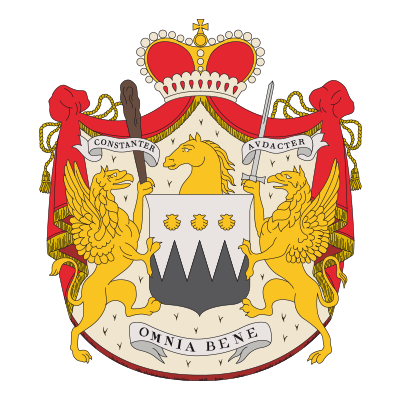
Inside, there are two courtyards, “closed” at the back by two open staircases, on which rests the coat of arms of the Ruffo family of the Castelcicala branch, surmounted by a half-rampant horse, which contains the family motto: nunquam retrorsum (never retreat).
The second courtyard (the setting for Bellavista’s films) has a double open staircase on the main side with three large round-arched windows on each of the three floors. The first courtyard, on the other hand, has a larger square window on each floor. On the right of the second courtyard, there is an ancient piperno well.