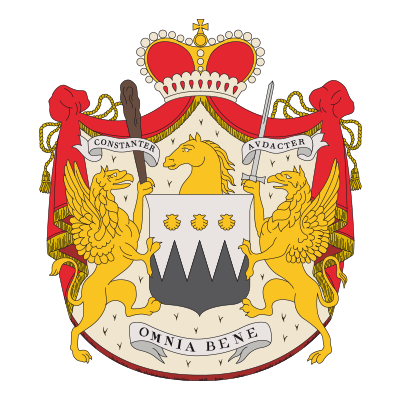
located in the historic centre of Nicotera, home to the 'Civic Archaeological Museum' and the 'Centre for the Study and Conservation of the Peasant Civilisation of the Poro'.
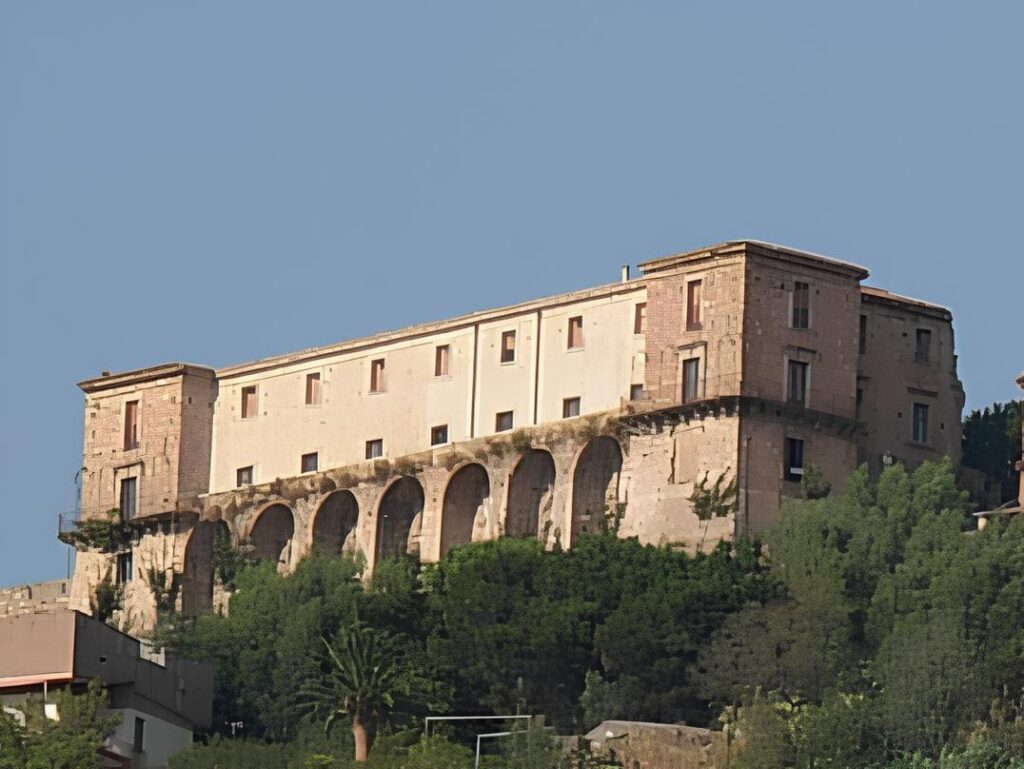

located in the historic centre of Nicotera, home to the 'Civic Archaeological Museum' and the 'Centre for the Study and Conservation of the Peasant Civilisation of the Poro'.
History
The current fortress is the work of architect Ermenegildo Sintes who, in 1764, converted the castle into a summer residence for Count Fulco Antonio Ruffo.
The building is thus the result of a series of reconstructions that the castle has undergone over the centuries. In fact, the building was erected on the ruins of the ancient Swabian-Angevin fortress, built on angular towers and large terraces, from which it is possible to see the marina below.
The first castle built in Nicotera was erected by the Norman Duke Robert the Guiscard in the second half of the 11th century to house a large military garrison to protect the coast and the town. To complete the conquest of southern Calabria, the fortress was handed over to his brother, Grand Count Roger the Norman, to serve as the administrative centre for the military structure, for the eventual conquest of neighbouring Sicily. The castle has been continuously destroyed and rebuilt throughout its life, due both to devastating earthquakes (in particular the earthquake of 27 March 1638) and the destruction wrought by Saracen assaults in 1074 and 1085; or the curious episode of 1284, when the castle was destroyed completely by the armed troops led by the Aragonese admiral Roger of Lauria, the man behind the expulsion of the Angevins from Calabria. The fortress was later rebuilt by Roger of Lauria himself.
With the advent of Frederick II, both the city and the castle underwent a process of expansion and fortification according to the Swabians’ artistic style, mainly with the construction and expansion of an arsenal near the port. Frederick II was the responsible for the main development of the town of Nicotera, so that the castle played a major role in the town’s layout.
During the course of its history, the castle hosted illustrious figures, such as St. Bruno of Cologne, St. Ludwig of Anjou, Pope Urban II, Joachim of Fiore and the Empress Constance of Altavilla.
Architecture
The structure, which is still incomplete today, was built a few metres from the remains of the previous Norman manor, of which only a few stone foundations and a cistern remain, partly incorporated into a nearby noble palace. The structure appears as a massive building dominating the Marina di Nicotera below, with the main façade showing marked similarities to the Certosa di San Martino in Naples.
The Ruffo di Nicotera castle has a quadrilateral layout, with three corner towers, also quadrilateral in shape. The fourth tower was never built. The two front towers, connected by a series of seven arches, are linked by a balcony supported by grey granite corbels. In addition to the fourth tower, part of the façade is also missing, having been destroyed by the violent earthquake of 1783 that struck the plain of Sant’Eufemia. The castle’s underground chambers can be reached from an entrance in the inner courtyard. The granite doorway leads to a barrel-vaulted corridor, which also provides access to the ground floor. The latter houses two large rooms, the first with a ribbed vault, while the second hall with a cross vault is illuminated by seven windows that open onto the seven arches of the main façade. In the castle courtyard, there is an archway leading to the atrium, paved with large granite slabs and adorned with a large staircase.
Legends tell how the castle was connected to Marina di Nicotera by secret passages, so much so that some prisoners in the castle, in order to verify the existence of these tunnels and allow them to carry out an escape plan, threw watermelons inside, which rolled until they reached Marina di Nicotera.
The castle today
After further renovation, the castle was converted into a museum. The ground floor, characterised by large halls, houses the Civic Archaeological Museum, while the first floor of the building houses the ‘Centre for the Study and Preservation of Rural Civilisation in Poro’.